


iGEM isn’t any old science fair. “The world’s biggest synthetic biology competition” brings together hundreds of student teams to build projects and solve problems using molecular biology. One 2025 team from Lambert High School in Georgia caught our attention when they cited our primer design protocol — then blew our minds with their project, called LANCET, in which they developed a novel diagnostic for Lyme disease.
 |
|
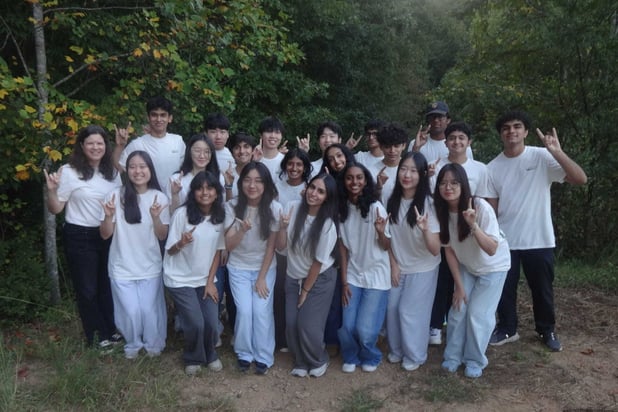
Figure 1: Lambert’s 2025 iGEM team. |
Most people are diagnosed with Lyme disease based on their symptoms and history of exposure to ticks. But without classic symptoms, a patient might instead be tested for antibodies against the bacteria that causes Lyme, Borrelia burgdorferi, which may not be detectable for several weeks after infection. The Lambert iGEM team wanted a target that could be detected sooner — as well as later, in cases where Lyme was not diagnosed immediately. They chose the target CspZ, a surface protein of B. burgdorferi that persists in the human bloodstream for over 100 days after infection, according to the team’s wiki page.
Their diagnostic works by joining several enzymatic steps. First, proximity-dependent ligation (PDL) joins two DNA aptamers that recognize CspZ (Guérin et al., 2025); this joining generates a novel reporter sequence, which T4 polymerase uses as a template to synthesize a complementary strand. Next, the DETECTR system combines recombinase polymerase amplification (RPA) to generate a detectable signal with Cas12a sequence recognition to specifically detect the joined-aptamer sequence. Once bound to the amplified target sequence, Cas12a indiscriminately cleaves ssDNA reporters, freeing fluorophores to be captured in a lateral flow assay for easy reading of the result. The team explains the process in this animation:
|
Figure 2: The LANCET diagnostic for Lyme disease. |
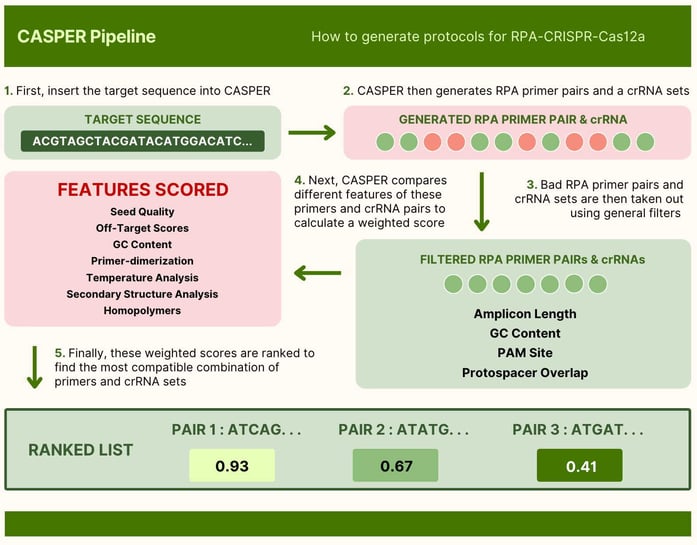
RPA and Cas12a have been combined before, including for diagnostic applications like COVID testing (Broughton et al., 2020; Chen et al., 2018). But the Lambert iGEM team was frustrated by the lack of sequence design tools that considered the requirements of both assays. The RPA primers and Cas12a sgRNA both needed to pair with different parts of the joined-aptamer sequence generated in the PDL step of the diagnostic.
Their solution to this problem won Best Software Tool from a high school team at the iGEM competition in Paris. They call it Combined Amplification & Spacer Engine for RPA-Cas12a (CASPER). CASPER produced a set of primers and sgRNA that experimentally outperformed the sequences generated separately by other tools, producing the highest concentration of cleaved reporters in a head-to-head comparison.
 |
|
Figure 2: CASPER pipeline. |
I was able to chat with a few of these students, Harsha Poonepalle and Sankalp Yeleti. This interview has been edited for length.
How did your team originally get interested in Lyme disease?
When we were figuring out our project for the year, we wanted to do something that could make a real impact close to home. We started looking into different problems and Lyme disease kept coming up. It's the most common tickborne disease in the US, with around 476,000 Americans infected every year, but it's still significantly underdiagnosed. The current test relies on antibodies that don't appear until at least two weeks after infection, so by the time you test positive, the bacteria has often already spread into your joints, heart, or nervous system. That gap between being infected and being able to diagnose it was where we saw the biggest need, and we thought synthetic biology could address it.
Have you thought about applying your approach to other diseases?
Yes, the wet lab pipeline behind LANCET is designed to be a modular system… The advantage is that you can swap in different aptamers and crRNAs to target almost any protein biomarker. Sepsis is one of the main directions we've considered because it's a leading cause of in-hospital deaths and treatment is highly time sensitive. iGEM co-founder Drew Endy said in the 60 Minutes segment that our platform isn't limited to Lyme and could detect essentially anything you can find in blood.
How did you start learning about CRISPR and related techniques?
Our school has a strong biotech program, so we take biotech classes that teach us the fundamentals of techniques like PCR, gel electrophoresis, transformation, and how CRISPR works before we even apply for the iGEM team. On top of that, our 2024 project SHIELD used CRISPR interference (a deactivated Cas9 paired with sgRNA) to silence genes in antibiotic-resistant bacteria. So by the time we got to 2025, we already understood how guide RNAs work and how to predict off target effects. Moving into Cas12a for diagnostics felt like a natural extension because it's the same family of enzymes, just used for cleavage instead of silencing.
Which part of the project was hardest to get working?
Two parts presented significant challenges. The first was getting Proximity Dependent Ligation to work with the CspZ protein. At first, our PCR runs on the PDL product showed no visible bands, which was discouraging. Our model had actually predicted this could happen. We weren't generating enough copies of the ligated product for anything downstream to detect. We ended up having to increase our aptamer concentrations significantly before we finally saw a clean band at around 200 base pairs, which is exactly where we expected it. Aptamer protein binding is sensitive to multiple variables like buffer, temperature, and how the aptamer folds, so dialing it in took a lot of trial and error.
The second hard part was making CASPER impactful to the community. It's not that difficult to write code that outputs primer and crRNA designs, but making sure those designs actually perform in the wet lab is significantly harder. We had to balance multiple competing criteria at once to optimize the effectiveness of our designs, weighing factors like specificity, thermodynamic compatibility, and structural stability against each other. To validate the model, we kept checking CASPER's predictions against our own wet lab results to see if the rankings matched, and they did, which was a real confirmation that the scoring framework actually translated to real-world performance.
Can you tell us a highlight from your competition in Paris?
The biggest highlight was being there together as a team after working on this all year. We'd spent months in the lab, pulled many all nighters writing up results and building our wiki, and then suddenly we were in Paris with over 400 teams from around the world. Getting to enjoy that experience together instead of stressing about deadlines felt earned.
For awards, winning Best Software Tool for CASPER was the most rewarding moment. With nominations you don't get to go on stage, but with a category win you do, and walking up there as a team after everything we put into it was an incredible feeling. We also placed in the Top 10 high school teams globally, which felt particularly meaningful because we were the only American team in that group. And we got nominations for Best Model, Best Education, Best Wiki, and Best Village Project too, which showed that the project was solid across the board, not just in one area.
Have there been any developments with your project since your 2025 competition?
Yes, we got invited to present at the 4th Annual Ticks and Tickborne Diseases Symposium at Johns Hopkins in Baltimore on April 29 and 30, 2026. The symposium is hosted by the Lyme and Tickborne Diseases Research and Education Institute, which is directed by Dr. Nicole Baumgarth, who is the same Lyme immunologist who advised us early on when we were picking CspZ as our biomarker. So it's a full circle moment, getting to come back and present results to the same community that helped us shape the project.
Have you shared CASPER with any of the researchers you spoke to while developing it?
Yes, and that was always the goal. We built CASPER because of a gap researchers told us about. When we were scoping out the project, multiple groups working on RPA CRISPR diagnostics told us they had to order around ten primer pairs at a time because no integrated tool existed. So sharing it back to that community was the whole point.
Specifically, we worked with Dr. Daniel Richards at ETH Zurich and Dr. Fengming Wang at the Changzhou Center for Disease Control and Prevention, who both gave us valuable feedback throughout the process. CASPER is also fully open source, so anyone in the scientific community can use it, review the code, or improve it. The scoring weights are configurable too, so other teams can adapt it to their own targets without having to rewrite the underlying framework.
What's next for members of your team?
Our seniors are heading off to college, and most of them are going to continue in STEM fields and bring what they learned in iGEM into university research. Our younger members are already getting started, learning from this year's team and beginning work on the 2026 project. That handoff every year is a major reason Lambert iGEM has been able to take on increasingly ambitious projects. Each team builds on what the last one figured out.
How is Lambert's iGEM 2026 project going?
It's going well so far. We've got our new team together and our project direction set. We're staying in the environmental space again and this time we're focusing on pollinator health, specifically working on Deformed Wing Virus in honeybees. DWV is one of the most damaging viruses for bee colonies worldwide, and considering how much of our food supply depends on pollination, we think it's exactly the kind of real world problem iGEM is built for. More updates as the season goes on.
Thanks to Harsha and Sankalp for their thoughtful responses, and to the Lambert iGEM faculty sponsor, Kate Sharer, for sharing Addgene resources with her students. Catch up with the team on their Instagram, and let us know in the comments if CASPER is useful for your research!
References and Resources
References
Broughton, J. P., Deng, X., Yu, G., Fasching, C. L., Servellita, V., Singh, J., Miao, X., Streithorst, J. A., Granados, A., Sotomayor-Gonzalez, A., Zorn, K., Gopez, A., Hsu, E., Gu, W., Miller, S., Pan, C.-Y., Guevara, H., Wadford, D. A., Chen, J. S., & Chiu, C. Y. (2020). CRISPR–Cas12-based detection of SARS-CoV-2. Nature Biotechnology, 38(7), 870–874. https://doi.org/10.1038/s41587-020-0513-4
Chen, J. S., Ma, E., Harrington, L. B., Da Costa, M., Tian, X., Palefsky, J. M., & Doudna, J. A. (2018). CRISPR-Cas12a target binding unleashes indiscriminate single-stranded DNase activity. Science, 360(6387), 436–439. https://doi.org/10.1126/science.aar6245
Guérin, M., Vandevenne, M., Matagne, A., Aucher, W., Verdon, J., Paoli, E., Ducrotoy, J., Octave, S., Avalle, B., Maffucci, I., & Padiolleau-Lefèvre, S. (2025). Selection and characterization of DNA aptamers targeting the surface Borrelia protein CspZ with high-throughput cross-over SELEX. Communications Biology, 8(1), 632. https://doi.org/10.1038/s42003-025-08034-7
Additional resources on the Addgene blog
Resources on Addgene.org
Topics: CRISPR



Leave a Comment