


Guiding a cell through differentiation to its eventual fate requires a precise recipe of molecular signals, with transcription factors (TFs) as the key ingredients. With the right combination of TFs, scientists can also reprogram cell identity in the lab. In immune cells, such reprogramming could be useful to treat cancer and autoimmune diseases — but only a handful of immune cell types have known TF recipes. The REPROcode platform from the Carlos-Filipe Pereira lab was built to change that.
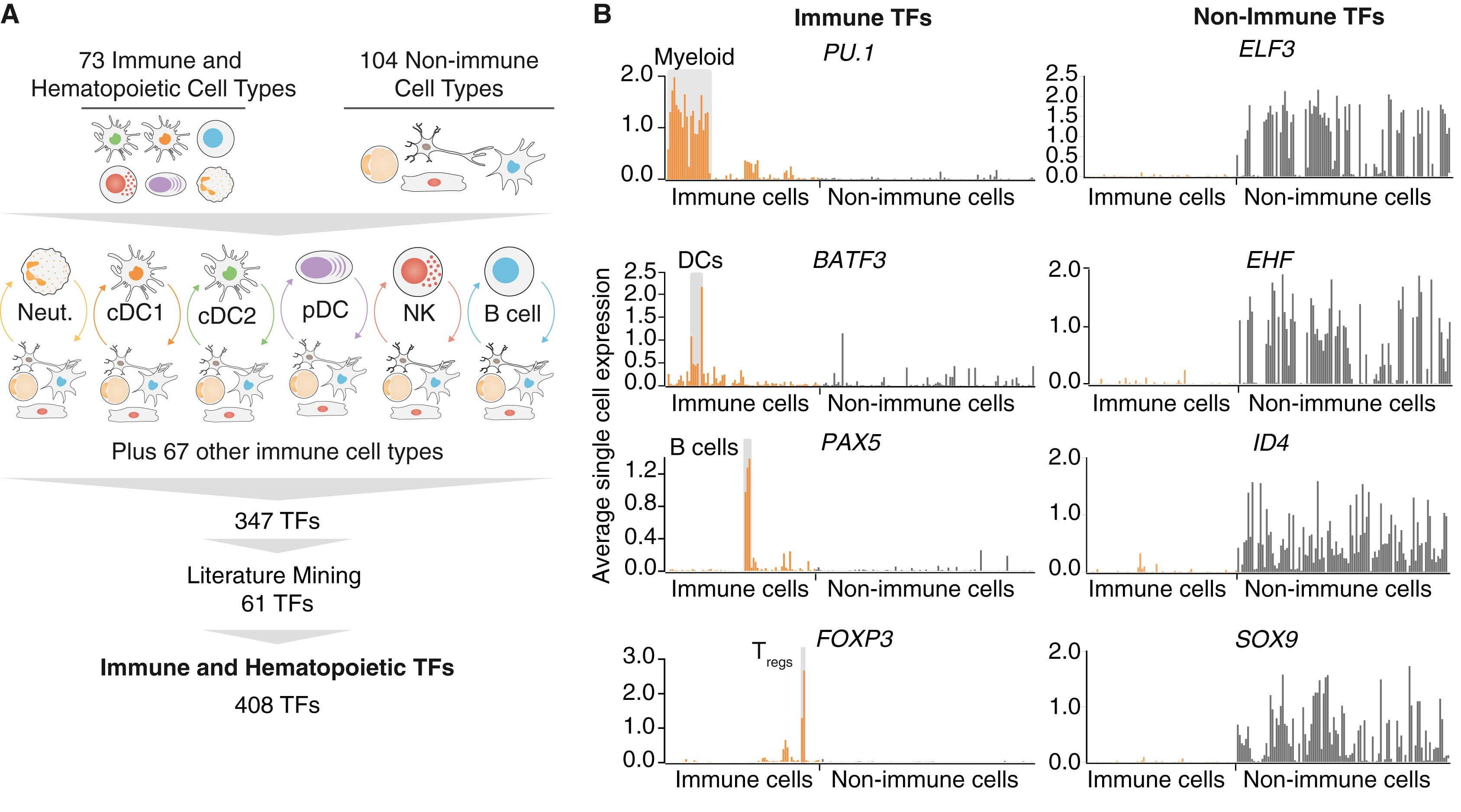
Imagine learning how to bake a cake by trying every possible combination of the ingredients to find out which ones taste good. REPROcode manages such an approach in high throughput to screen TF combinations for their ability to reprogram immune cells. The collection consists of 408 barcoded lentiviral vectors encoding TFs specific to the immune system (Figure 1).
 |
|
Figure 1: (A) Selection of the 408 TFs for REPROcode. Starting from a library of 1829 TFs, expression levels were compared between 73 hematopoietic/immune cell types and 104 non-immune cell types. The 347 TFs with the highest specificity for immune cells (the 6 shown and 67 others) were combined with 61 TFs previously reported to be involved in hematopoietic reprogramming. (B) Average gene expression levels of selected immune (left) and non-immune (right) TFs across immune and non-immune cell types. The gray box highlights the immune lineage where corresponding immune TFs are enriched. DCs = dendritic cells; Tregs = regulatory T cells. Figure reproduced from Kurochkin et al (2026) under a CC-BY 4.0 license. |
Luckily, you don't have to whip up those immune cells without guidance, as the Pereira lab has also provided a full protocol for using their platform in a separate publication (Altman et al., 2026). While the protocol provides instructions for using human embryonic fibroblasts, the team demonstrated efficacy in multiple cancer cell lines as well. Following arrayed virus production, vectors are pooled and co-transduced into human cells. After ~10 days, flow activated cell sorting (FACS) separates the reprogrammed from non-reprogrammed cells, and single-cell RNA sequencing captures the unique transcriptional state of each cell. The library barcodes are designed to be detected directly from the RNA transcript without amplification, simplifying this step. By comparing the presence and combination of various TFs in the reprogrammed versus non-reprogrammed cells, the platform provides insight into the appropriate TF “recipe” for different cell types.
The team’s first screen was a proof of concept: could REPROcode identify the known minimal TF combination to produce cDC1s? Not only did the “PIB” combination emerge from the nine pooled TFs, the platform also clarified the optimum stoichiometry of each TF and identified additional TFs that enhance reprogramming (Kurochkin et al., 2026).
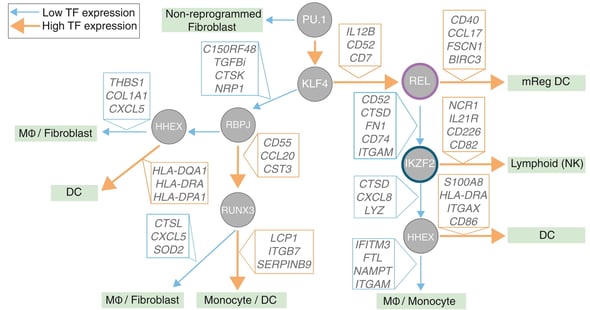
Next, they aimed bigger: using a pool of 48 TFs to generate a range of immune cells. These results allowed them to construct a hierarchy map showing key TF branching points leading to various cell fates (Figure 2).
 |
|
Figure 2: Hierarchy of TF-driven cell fate reprogramming. Decision TFs are shown in gray circles, while signature pathway genes are shown for each arrow. mReg = mature regulatory; NK = lymphoid natural killer cells, DCs = dendritic cells; MΦ = macrophages. Figure reproduced from Kurochkin et al (2026) under a CC-BY 4.0 license. |
The combinatorial approach provides simultaneous information on reprogramming efficiency, TF stoichiometry, and even transcriptional subpopulations within cell types. Even larger screens may be possible with further optimization!
Thanks to the Pereira lab for depositing their immune-specific collection. Looking for TFs beyond the immune system? Addgene has options for that too:
- the Multiplexed Overexpression of Regulator Factors (MORF) Collection or pooled library from the Feng Zhang lab
- the Human TFome Library from the Marc Vidal, George Church, and Jussi Taipale labs
- the Plant TF Library from the Silin Zhong lab
Ready to cook up some immune cells? The REPROcode collection has the ingredients you need!
References and resources
References
Altman, A. R., Pértiga-Cabral, D., Pereira, C.-F., & Kurochkin, I. (2026). Protocol for identifying cellular reprogramming minimal networks using combinatorial transcription factor screening. STAR Protocols, 7(2). https://doi.org/10.1016/j.xpro.2026.104527
Kurochkin, I., Altman, A. R., Caiado, I., Pértiga-Cabral, D., Halitzki, E., Minaeva, M., Zimmermannová, O., Henriques-Oliveira, L., Klein, D., Nair, M., Oliveira, D., Cajal, L. R., Knittel, R., Feick, C., Ringnér, M., Martin, M., Cirovic, B., Pires, C. F., Rosa, F. F., … Pereira, C.-F. (2026). A combinatorial transcription factor screening platform for immune cell reprogramming. Cell Systems, 17(1). https://doi.org/10.1016/j.cels.2025.101457
Additional resources on the Addgene blog
- Lentiviral Vector Uses and Overview
- Antibodies 101: Flow Cytometry
- Starter Guide to Induced Pluripotent Stem Cells (iPSCs): Reprogramming and Transdifferentiation
- Multiplexed Overexpression of Regulatory Factors (MORF) collection



Leave a Comment