


Modeling is not just a job for humans — it is also a job for many different organisms. And like human modeling, biological modeling turns out to be surprisingly glamorous and diverse. But what comes to mind when you picture a “model organism”? A mouse? A pesky fruit fly? Science’s favorite worm, the nematode? Or, if you’re a plant person, maybe a mustard weed?
While these — plus many more organisms like yeast and zebrafish — are by far the most common model systems, they are not the only ones. Some scientists are braving the frontier of lesser-studied organisms, hoping to reveal unexpected, but useful, biological phenomena. I was lucky enough to be one of those scientists, studying naked mole-rats and their remarkable cancer resistance (ironically, by trying to give them cancer, but I digress). Of course, my lab was not the only one pushing the boundaries of model organisms and testing the limits of what nature can teach us.
 |
|
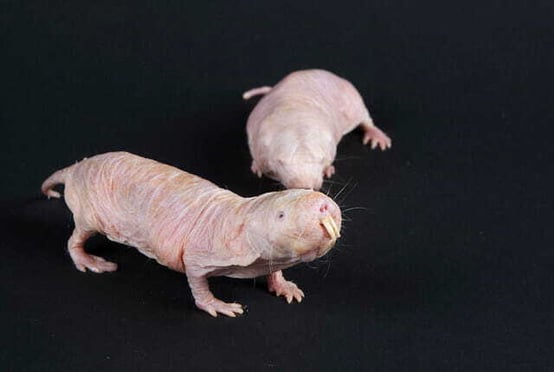
Figure 1: Naked mole-rats: the cutest animals in existence. Photo Credit: Meghan Murphy, Smithsonian’s National Zoo. Under Creative Commons License 2.0 (CC BY-NC-ND 2.0). |
What is a non-model organism?
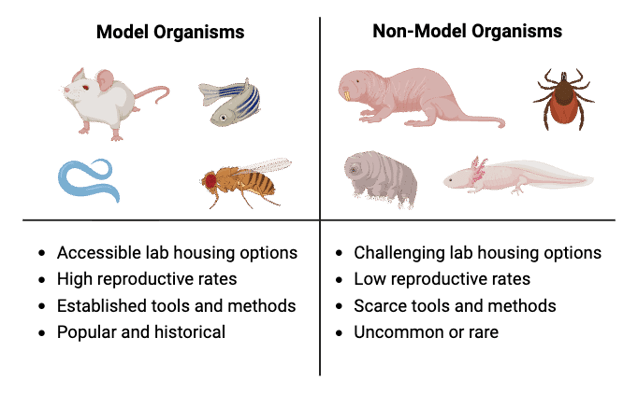
The name “non-model” is a little misleading. These organisms still serve as, well, models, but they are not the common ones most labs use. A more descriptive title would be “non-conventional model organism,” but alas I am not the one in charge of names. Organisms end up in this category for several reasons, chief among them that they historically have not been studied in lab settings. This is often due to factors such as long lifespans, difficulties rearing them in a lab, low reproductive rates, and a lack of established tools for genetic and biological study.
 |
|
Figure 2: Comparison of model and non-model organisms. |
Non-model organisms are not necessarily rare, and you’ve likely heard of many of them. Naked mole-rats, which I mentioned earlier, might be familiar (especially if you watched Kim Possible as a kid), and they are becoming increasingly common in lab settings. Other familiar names are octopuses, sea anemones, and ticks. Each one draws scientists' attention for a specific reason, and like the models themselves, those reasons are wonderfully varied.
What non-model organisms can teach us
If they’re difficult to raise, difficult to use, and difficult to study, why bother? While their unique properties may make them challenging lab models, those same unusual traits can also help answer unusual questions, or shed light on long-standing hypotheses. For example, a comparative study of humans, mice, and a range of non-model organisms (including naked mole-rats, horses, giraffes, cats, and ferrets, among others) offered insight into somatic mutation rates across species of differing body size and longevity (Cagan et al., 2022).
This provided useful context for the long-standing theory that accumulating mutations contribute to cancer risk and aging. By looking beyond the usual suspects (humans, mice, rats, etc.), the researchers found an inverse correlation between somatic mutation rate and longevity: the longer-lived the species, the more slowly its mutations tended to accumulate. It may sound intuitive, but that evidence was only possible by studying a wide range of organisms outside the norm.
Comparative studies can also be useful in evolutionary biology, especially when looking at closely related species. Tracing how genes change at evolutionary branching points reveals a lot about how genes evolve in general. Many such studies focus on groups that have many closely related species available, like fungi (Naranjo‐Ortiz & Gabaldón, 2020). However, these studies are not limited to more readily-available organisms. Scientists have also applied these approaches to a wide range of organisms to understand their evolutionary histories, including bees and crayfish (Bonassin et al., 2025; Cook et al., 2025).
Outside of larger comparative studies, individual organisms may have unique or unusual traits that, if understood at the biological level, could impact human health. At the risk of yet more naked mole-rat cheerleading: they live extraordinarily long for a rodent (over 30 years in captivity!), yet develop spontaneous cancers at strikingly low rates. If we could work out the biology behind that resistance, we might be able to apply it to cancer prevention in humans.
Other non-model organisms are studied because they cause or carry disease — ticks are a great example. They transmit a range of diseases, most infamously Lyme disease, and their range and abundance have been expanding in recent years (Eisen et al., 2017; Rowan et al., 2023). To counter that growing threat, we have to understand its source. By investigating tick biology, we can better understand disease transmission, but just as importantly, how to address rising tick populations and develop strategies to blunt the diseases they carry.
Non-models at Addgene
A major challenge of working with non-models is the shortage of information and tools. Because these organisms are studied by relatively few labs, sharing what we learn is essential to getting the most out of them. As anyone who has worked with a non-model can attest, the hardest part is often assembling the basic tools and knowledge, like a sequenced genome or antibodies that recognize your species. I spent the first couple of years of my PhD building and testing the tools we needed to make a genetic model, work that wouldn’t be necessary in mice.
Addgene’s collections for common model organisms are vast, but we also store and distribute resources for non-models. Here are just a few examples:
Non-Model Organism Resources at Addgene
| Model | Research focus | Depositing lab | Additional links |
| Aquatic species | |||
| Axolotl | Limb regeneration | Elly Tanaka | n/a |
| Hydra | Cell differentiation | Brigitte Galliot | n/a |
| Killifish | Aging | Itamar Harel | Moses et al. |
| Octopus | Temperature effects on RNA editing | Joshua Rosenthal | Birk et al. |
| Sea anemone | Development, regeneration, and tool development | Matthew Gibson | n/a |
| Tardigrade | In vivo tardigrade expression and anhydrobiosis | Kazuharu Arakawa | Tanaka et al. |
| Mammalian species |
|||
| Ferret | Brain structures | Cliff Ragsdale | Rowell et al. |
|
Insect species
|
|||
| Tick | Disease and tool development | Monika Gulia-Nuss | n/a |
| Tribolium castaneum (beetle) | Tool development | Michalis Averof | |
| Fungal species | |||
| Aureobasidium pullulans (fungus) | Environmental adaptation, cell morphology, and tool development | Daniel Lew | n/a |
| Chytrid fungus | Unique cellular structures and disease | Lillian Fritz-Laylin | |
| Kits and libraries |
|||
| Multiple | Modular TALEN cloning kit | Takashi Yamamoto | Platinum Gate TALEN Kit |
| Non-model bacteria | Modular toolkit to identify functional transposases | Cultivarium | JERBOA Kit |
| Salpingoeca rosetta | Genome evolution and differentiation | Nicole King | |
| Toxoplasma gondii (parasite) | Disease and tool development | Sebastian Lourido | Toxoplasma CRISPR Knockout Pooled Library |
[Non]-modeling future discoveries
When it comes to non-model organisms, sharing matters even more. Using these unique systems often comes with few tools and resources to start even the most basic experiments. Many labs have to build infrastructure for housing and husbandry from the ground up, while also developing and testing the basic tools required for molecular biology. By sharing whatever knowledge and resources they can, non-model labs move both their own work and the wider field forward, and help bring to light important biology that might otherwise stay hidden.
Do you work with a non-model organism? Consider sharing your resources with Addgene!
References and Resources
References
Bonassin, L., Boštjančić, L. L., Rutz, C., Francesconi, C., Schardt, L., Baranski, D., Greve, C., Pârvulescu, L., Besendorfer, V., Mlinarec, J., Maguire, I., Theissinger, K., & Lecompte, O. (2025). The extraordinary satellitome diversity of freshwater crayfish: a driver of genome evolution. Mobile DNA, 17(1). https://doi.org/10.1186/s13100-026-00399-8
Cagan, A., Baez-Ortega, A., Brzozowska, N., Abascal, F., Coorens, T. H. H., Sanders, M. A., Lawson, A. R. J., Harvey, L. M. R., Bhosle, S., Jones, D., Alcantara, R. E., Butler, T. M., Hooks, Y., Roberts, K., Anderson, E., Lunn, S., Flach, E., Spiro, S., Januszczak, I., . . . Martincorena, I. (2022). Somatic mutation rates scale with lifespan across mammals. Nature, 604(7906), 517–524. https://doi.org/10.1038/s41586-022-04618-z
Cook, H. L., Sproul, J. S., Murray, E. A., & Bossert, S. (2025). A comparative analysis of transposable element diversity and evolution across 75 bee genomes. BMC Genomics, 26(1), 1000. https://doi.org/10.1186/s12864-025-12190-9
Eisen, R. J., Kugeler, K. J., Eisen, L., Beard, C. B., & Paddock, C. D. (2017). Tick-borne zoonoses in the United States: Persistent and emerging threats to human health. ILAR Journal, 58(3), 319–335. https://doi.org/10.1093/ilar/ilx005
Naranjo‐Ortiz, M. A., & Gabaldón, T. (2020). Fungal evolution: cellular, genomic and metabolic complexity. Biological Reviews, 95(5), 1198–1232. https://doi.org/10.1111/brv.12605
Rowan, S., Mohseni, N., Chang, M., Burger, H., Peters, M., & Mir, S. (2023). From tick to test: A comprehensive review of tick-Borne disease diagnostics and surveillance methods in the United States. Life, 13(10), 2048. https://doi.org/10.3390/life13102048
Russell, J. J., Theriot, J. A., Sood, P., Marshall, W. F., Landweber, L. F., Fritz-Laylin, L., Polka, J. K., Oliferenko, S., Gerbich, T., Gladfelter, A., Umen, J., Bezanilla, M., Lancaster, M. A., He, S., Gibson, M. C., Goldstein, B., Tanaka, E. M., Hu, C., & Brunet, A. (2017). Non-model model organisms. BMC Biology, 15(1), 55. https://doi.org/10.1186/s12915-017-0391-5
Shepard, A., & Kissil, J. L. (2020). The use of non-traditional models in the study of cancer resistance—the case of the naked mole rat. Oncogene, 39(28), 5083–5097. https://doi.org/10.1038/s41388-020-1355-8
Additional resources on the Addgene blog
Additional resources on addgene.org
Topics: Model Organisms



Leave a Comment