


Every few months we highlight some of the new plasmids, antibodies, viral preps, and other materials in the repository through our Hot Plasmids articles. This month, we’ve got some new biosensors for neuroscience research, popular plasmids for a common lab enzyme, and more!
 Read on to find:
- Plasmids and recipes for homemade benzonase
- New isotype control antibody from IPI
- Next-generation norepinephrine biosensors
- A new approach for screening T cell receptors
Turbocharge your preps with homemade benzonase
By Mike Lacy
Removing excess nucleic acids from your cell lysate is a critical step in many lab processes, such as purifying recombinant proteins, producing viral vectors, and more. Your protocol might call for adding an enzyme like the Serratia marcescens endonuclease (SerMNucA, also known as Turbonuclease or Benzonase) for this reason. SerMNucA efficiently degrades both DNA and RNA, is extremely stable, and is commercially available. But if you’re buying large amounts of it for big preps or frequent use, the cost can add up.
 |
|
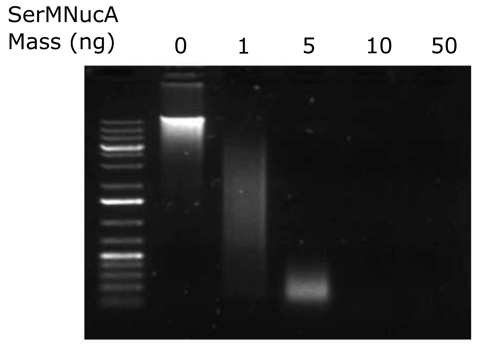
Figure 1: Efficient DNA degradation by recombinant SerMNucA-His incubated with salmon sperm DNA for 30 minutes. Adapted from Rieubon et al., 2026 under CC BY license. |
Fortunately, the Pojer and Arrowsmith Labs have shared plasmids you can use to express and purify your own supply of this recombinant enzyme at a fraction of the price; you can choose 10xHis-, MBP-, or myc-tagged SerMNucA, depending on your preference or needs. Plus, the MBP-Benzonase plasmid is available to industry as well as academic scientists. And in Rieubon et al. (2026), they provide a detailed protocol for expression and purification along with validation and expected results (Figure 1). Nearly 100 labs have ordered these plasmids already. Join them and turbocharge your own preps today!
Find SerMNucA Benzonase plasmids here!
Rieubon, L., Lim, M., Lau, K., Pojer, F. (2026). Purification of SerMNucA (Benzonase/Turbonuclease) as 10xHis, MBP or myc-tag fusions. protocols.io, doi: https://dx.doi.org/10.17504/protocols.io.261ged7xov47/v2.
Rabbit IgG Isotype Control from IPI
By Ashley Waldron
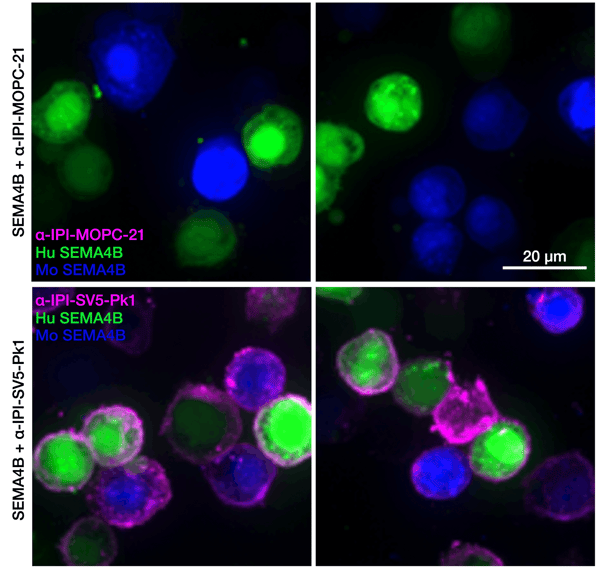
We are excited to now offer a rabbit IgG isotype control made by our partners at IPI (Figure 2). Isotype control antibodies are important tools used in a variety of antibody-based experiments. These types of antibodies are not specific to any known targets themselves, but instead help you identify staining due to Fc receptor or other protein-protein interactions with your sample. Comparing staining between your primary antibody and a matched isotype control allows you to distinguish between specific and non-specific staining and interpret your results with confidence. If you are using any of the 70+ rabbit IgG recombinant primary antibodies distributed by Addgene, this new Rabbit IgG Isotype Control [IPI-MOPC-21] antibody (Addgene #237822) could be a natural pairing. Check out the antibody page and Data Hub reports to learn more and see if it's the right tool for your next experiment!
 |
|
Figure 2: Immunofluorescence of ExpiCHO cells transfected with human (green) or mouse (blue) SEMA4B-V5 and labeled with IPI-MOPC21 (Addgene #237822) (top row, magenta) or Anti-V5 [IPI-SV5-Pk1] (Addgene #218107) (bottom row, magenta). Scale bar: 20 μm. Image from Morano et al. 2026. Addgene Report https://doi.org/10.57733/addgene.6tylmq reproduced under CC BY license. |
Find the Rabbit IgG Isotype Control Antibody here!
Red light, green light: New norepinephrine biosensors
By Mike Lacy
Norepinephrine is a critical neuromodulator. Fluorescent biosensors have enabled live imaging and in vivo monitoring of norepinephrine, but the recent first-generation tools are still somewhat limited. Following up on their first GPCR-based norepinephrine biosensors nLightG and nLightR, Tommaso Patriarchi’s lab has now developed a pair of substantially improved sensors, nLightG2 and nLightR2 (Rohner, et al., 2026).
The sensors consist of the alpha-1a adrenergic receptor fused with a circularly permuted GFP (nLightG/nLightG2) or mApple (nLightR/nLightR2) for green and red fluorescence reporting, respectively. Inspired by recent improvements on another GPCR-based reporter for dopamine, GRABDA3m, Rohner et al. tested a variety of mutations in the nLight reporter domains. The resulting constructs, nLightG2 and nLightR2, had significantly better brightness and sensitivity in vivo compared to the previous nLight and GRABNE2 sensors in a variety of imaging types and behavioral contexts.
 |
|
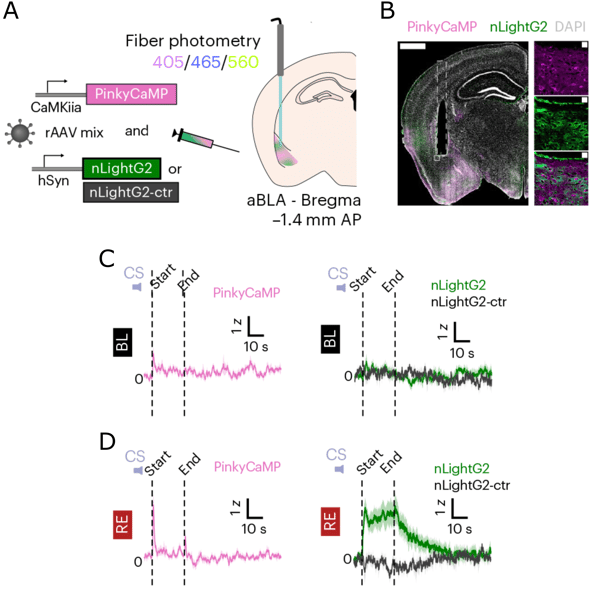
Figure 3: Application of nLightG2 for dual-color fiber photometry in fear conditioning experiments in mice. A) Surgery schematic and AAV constructs. B) Micrographs of mouse brain coinjected with PinkyCaMP (magenta) and nLightG2 (green) rAAVs, showing reporter expression and optic fiber location (dashed lines); scale bars, 1,000 µm (overview image) and 20 µm (magnification images). C,D) Mean ± s.e.m. signal z-score from PinkyCaMP and nLightG2 or nLightG2-ctr in baseline (BL) session (C) or re-exposure (RE) session after fear conditioning (D); CS: conditioned stimulus tone. Adapted from Rohner et al. (2026) under CC BY license. |
The team demonstrated multiplex imaging of nLightG2 with PinkyCaMP (Figure 3) and two-photon imaging of nLightR2 with GCaMP6. Though unfortunately, nLightR2 is incompatible with some reporters or optogenetic tools due to photoswitching upon strong blue-light illumination. In addition to enabling better tracking of norepinephrine dynamics in vivo, these new sensors demonstrate a promising route to future improvements for these and related tools so keep an eye out for further-improved versions! Both are available as AAV Packaged on Request, and look for in-stock AAV preps coming soon.
Find nLightG2 and nLightR2 plasmids here!
Rohner, V. L., et al. (2026). Next-generation multicolor indicators for in vivo imaging of norepinephrine. Nature Methods, 23(3), 636–652. https://doi.org/10.1038/s41592-026-03006-z.
TCRAFT: A new approach for screening T cell receptors
By Emily P. Bentley
The diversity and flexibility found in your immune cells enables the fascinating adaptive system that defends your body from pathogens… but it sure does make immunology difficult! Consider that a human can have a hundred million different T cell receptor (TCR) sequences, combining in pairs to create unique vast numbers of potential TCRs. The Michael Birnbaum Lab aimed to address the challenge of mapping TCRs to the antigens they recognize, in one scalable, efficient workflow.
The Birnbaum Lab’s approach is called TCRAFT: TCR rapid assembly for functional testing. It builds synthetic TCRs in a pooled format, using Golden Gate assembly to ensure components are appropriately matched. Briefly, libraries of linked TCR3α/β sequences are obtained by single-cell sequencing. The complementarity determining region (CDR) α- and β-chain sequences remain linked on the same oligonucleotide in a synthesized library, where each oligo also contains short unique sequences from α- and β-chain variable (TRAV and TRBV) and constant (TRAC and TRBC) genes. These sequences include 4-base overhangs for Golden Gate cloning, allowing them to snap together in the right order for pooled assembly (Figure 4).
|
|
|
Figure 4: Schematic of pooled TCR assembly method. Step 1 inserts oligos of paired CDR3β-α sequences into TRBV-TRAC vectors to generate TRBV-CDR3β-CDR3α-TRAC. Step 2 inserts TRBC-P2A-TRAV fragments between CDR3β and CDR3α to generate complete TCRs. Step 3 transfers the complete TCRs to an expression vector. TCR libraries are expressed in cells via lentiviral transduction at a low MOI. All steps are completed via Golden Gate assembly. Reproduced from Gaglione et al., 2026, under a CC BY-NC-ND 4.0 license. |
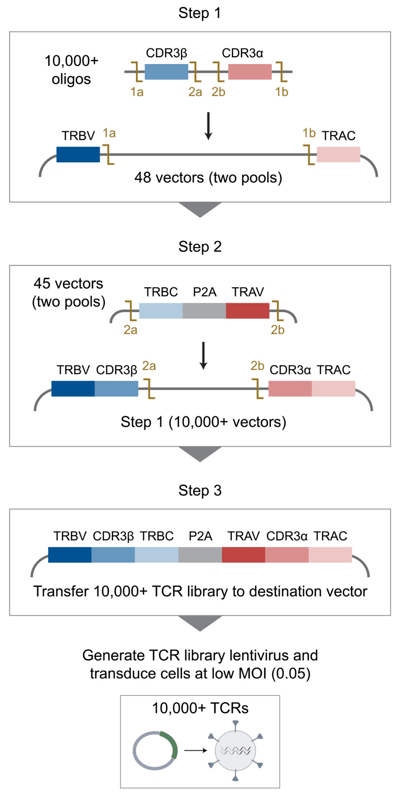
To screen the TCR library against antigens, the team combined TCRAFT with their other recently developed approach of receptor-antigen pairing by targeted retroviruses (RAPTR) and with peptide-pulsed antigen-presenting cell screening. TCRAFT also allows antigen specificity to be linked to gene expression data. In validating their method, they applied TCRAFT both to an autoimmune disorder, vitiligo, and to tumor-recognizing cells in pancreatic cancer, both applications where identifying TCR-antigen pairs is critical for understanding and treating these diseases. TCRAFT plasmids are available individually, as a kit, and in ready-to-screen pooled library format, so you can choose your starting materials depending on your experiment’s needs.
Find all the TCRAFT materials here!
Gaglione, S. A., et al. (2026). Scalable TCR synthesis and screening enable antigen reactivity mapping in vitiligo. Immunity, 59(2), 477-493.e9. https://doi.org/10.1016/j.immuni.2026.01.001.
That's all for now! If you've tried these tools in your lab, let us know what you think in the comments below.
Topics: Hot Plasmids



Leave a Comment