


Each plasmid in Addgene’s collection contains a story, hidden in the wealth of data all plasmids come with. The story tells who made the plasmid, who is using it, where it comes from and where it’s going, what it does, and even what advancements it has helped make.
Every few years, we do a deep dive into our CRISPR plasmid data, to see how it reflects the changing CRISPR field and Addgene’s role in it. Since our previous publication in 2023, the field has progressed in many areas, including in CRISPR-based medicines. In terms of statistics, not much has changed — the CRISPR community has remained consistent, active, and engaged, reflected in plasmid deposits and requests, which have settled into steady numbers. This time, we also investigated how these plasmids are being used, including applications, expression systems, and citations.
Read the full publication in The CRISPR Journal!
Addgene’s CRISPR collection continues to grow through collaboration
Addgene’s CRISPR plasmid collection started in 2012 with a total of 28 plasmids from the Jennifer Doudna, Feng Zhang, and George Church labs. Since that point, the collection has grown to over 20,000 CRISPR plasmids from over 1,400 labs around the world. These plasmids have been put to work by the larger CRISPR community: between 2012–2025, CRISPR plasmids were requested an astonishing 326,557 times and have amassed over 30,000 citations! While the number of requests is no longer increasing year-by-year, the requests remain steady, showcasing the continued activity in the field.
This activity is maintained through a collaborative effort. We see strong contributions from new labs every year that complement those from returning labs (Figure 1). It isn’t just the same labs investigating and creating new developments, it’s truly a collaborative effort from scientists around the world.
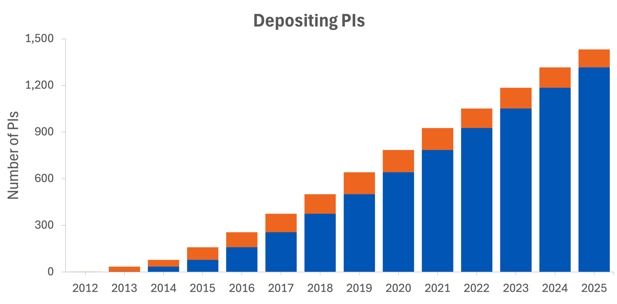 |
| Figure 1: Cumulative number of labs depositing CRISPR materials, 2012–2025. New depositing labs each year are indicated in orange. |
A diverse collection for specific applications
As our CRISPR collection has grown, so have the experimental possibilities. CRISPR has even reached outside the lab and into recent FDA-approved treatments. We took a look into these specific applications (Table 1) to see if we could gain any insights into how researchers are utilizing the plasmids in our CRISPR collection.
| CRISPR Application | Description |
| CRISPR Cloning Backbones | Empty, cloning-ready backbones containing a nuclease and a gRNA scaffold, or just the gRNA scaffold (not including a spacer targeting a specific genomic location) |
| Cas9 Nucleases | Plasmids containing just a Cas9 nuclease |
| gRNAs & HDR Templates | Plasmids containing a specific CRISPR accessory, either a gRNA targeting a specific sequence, a targeting gRNA plus a nuclease, or an HDR template. All targeting gRNAs are placed in this category (except for pegRNAs) |
| CRISPRi/a | Plasmids designed for CRISPR inhibition or activation |
| dCas9 & Nickases | Plasmids containing just a deactivated Cas9 (dCas9) or Cas9 nickase (nCas9) |
| Base Editing | Plasmids designed for base editing |
| Prime Editing | Plasmids designed for prime editing, including pegRNA plasmids |
| Cas12 | Plasmids containing just Cas12, including dCas12 and nCas12 |
| RNA Targeting | Plasmids designed for RNA targeting and editing, and containing a Cas13 or CasRx |
| Epigenetic Editing | Plasmids designed for epigenetic editing |
| Other CRISPR Tools | CRISPR plasmids that do not fall into the above categories. Includes plasmids for protein tagging, CRISPR transposases, CRISPR reporters, anti-CRISPR constructs, and other nucleases such as Cas3 and CasX |
The type of CRISPR application has varied widely for deposits over the years, while requests have a more consistent distribution across applications (Figure 2). This trend has continued since our previous publication, where we speculated that deposits were more influenced by changing research trends year by year. In contrast, the consistent ratio of CRISPR applications since the introduction of prime editors suggests that despite continued advancements, there is a continued need for more established technologies as well.
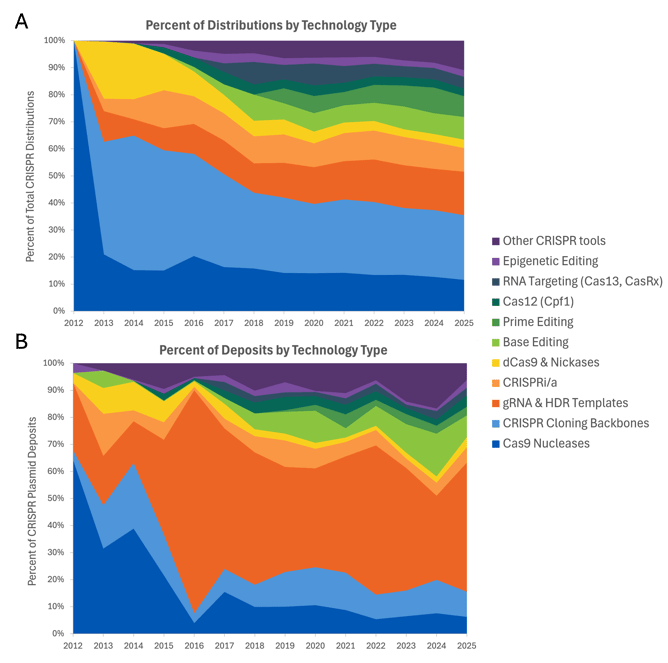 |
| Figure 2: Percentages of CRISPR applications represented in deposits and distributions from 2012–2025. Percentages are determined from total yearly deposits or distributions. (A) Yearly comparison of the percent of requested plasmids by CRISPR application. (B) Yearly comparison of the percent of deposited plasmids by CRISPR application. |
CRISPR cloning backbones and Cas9 nucleases continue to make up the majority of requested plasmids. Interestingly, most of these requests were made for cloning backbones for lentiviral expression (Figure 3). This could reflect the specific uses of these plasmids, as backbones and Cas9 plasmids are useful for generating stable cell lines or in vivo models. Other CRISPR technologies, like base and prime editing, are more often utilized in species-specific expression plasmids, reflecting their specific use cases and the continued need for a variety of both CRISPR tools and expression systems.
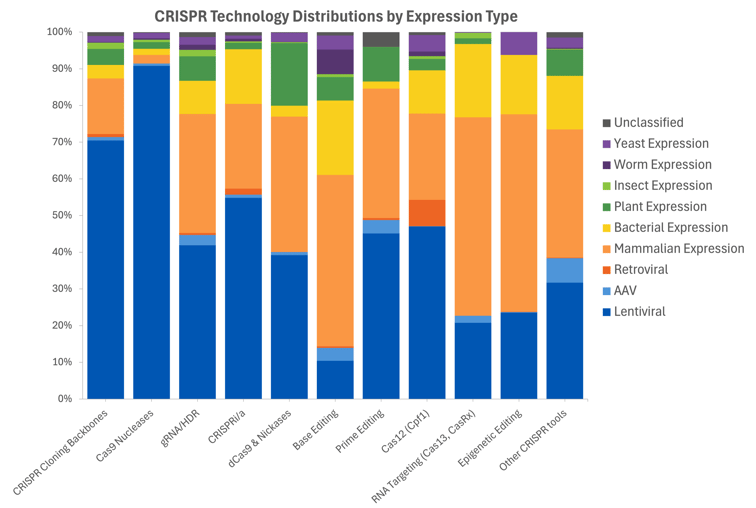 |
| Figure 3: Total distribution of CRISPR applications segmented by plasmid expression type. |
Facilitating a global reach
We are proud to support depositors from around the world, who are continuously dedicated to sharing their resources and knowledge with Addgene and, in turn, other researchers. Addgene has facilitated the distribution of CRISPR plasmids to over 100 countries, providing unprecedented access to this disruptive technology since its introduction. While the United States remains the top country for both deposits and distributions, there is a core community of researchers in all global regions, including Europe, Asia, and Oceania. In fact, the top 10 countries for deposits and distributions have remained the same since 2023 (Figure 4). Addgene will continue to support the CRISPR community in these and other countries, and expand the reach and impact of CRISPR to areas with limited access to other resources.
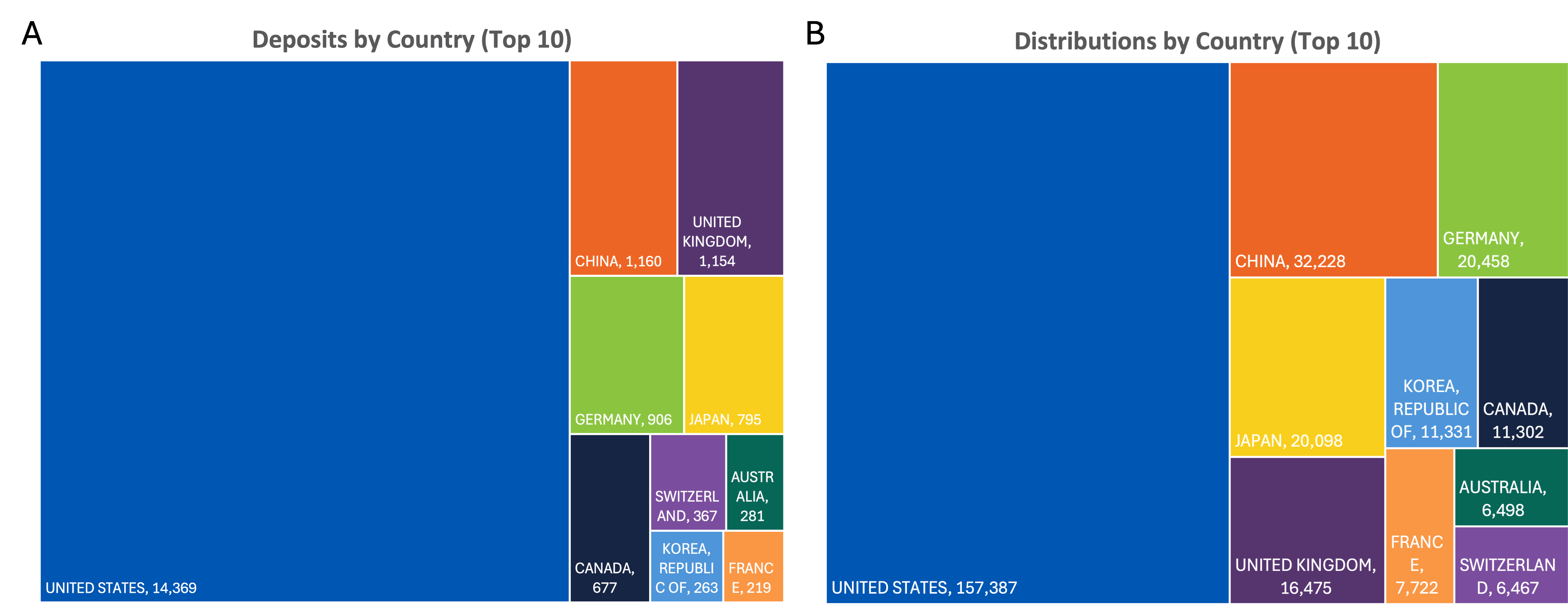 |
| Figure 4: Top 10 countries for deposits and distributions of CRISPR plasmids. (A) Top 10 depositing countries. (B) Top 10 requesting countries. |
An exciting future for a maturing technology
For the first decade of its widespread use, CRISPR met the definition of an emerging technology: (1) radical novelty, (2) fast growth, (3) coherence, (4) prominent impact, and (5) uncertainty and ambiguity. However, we now argue that it may be time to start considering CRISPR mature.
A mature technology does not mean an inactive one. Rather, it has become so integrated into our research systems that it is no longer novel, but considered a necessity in many cases. The statistics we’ve looked through show this — a continually active, engaged community that is celebrating not only established CRISPR methods, but excited and invested in new applications. We are proud to have supported the CRISPR community for the past 15 years, and will continue to do so for the years to come!
References and Resources
References
Davies, K., Philippidis, A., & Barrangou, R. (2024). Five years of progress in CRISPR clinical trials (2019–2024). The CRISPR Journal, 7(5), 227–230. https://doi.org/10.1089/crispr.2024.0081
Musunuru, K., Grandinette, S. A., Wang, X., Hudson, T. R., Briseno, K., Berry, A. M., Hacker, J. L., Hsu, A., Silverstein, R. A., Hille, L. T., Ogul, A. N., Robinson-Garvin, N. A., Small, J. C., McCague, S., Burke, S. M., Wright, C. M., Bick, S., Indurthi, V., Sharma, S., . . . Ahrens-Nicklas, R. C. (2025). Patient-Specific in vivo gene editing to treat a rare genetic disease. New England Journal of Medicine, 392(22), 2235–2243. https://doi.org/10.1056/nejmoa2504747
Pyhtila, B., Kasowitz, S., Leeson, R., & Barrangou, R. (2023). The expanding dissemination and distribution patterns of diverse CRISPR plasmids by Addgene. The CRISPR Journal, 6(6), 493–501. https://doi.org/10.1089/crispr.2023.0059
Rotolo, D., Hicks, D., & Martin, B. (2015). What is an Emerging Technology? Research Policy, 44(10), 1827–1843. https://doi.org/10.1016/j.respol.2015.06.006
Shepard, A., Minones-Moyano, E., Mork, C., Pyhtila, B., & Barrangou, R. (2026). The Diversifying Distribution Trends of Maturing CRISPR Technologies by Addgene. The CRISPR Journal, 25731599261470096. https://doi.org/10.1177/25731599261470096
Additional resources on the Addgene blog
- Build Your CRISPR Vocabulary
- Typing CRISPR Systems
- The Advances Behind the World’s First Personalized CRISPR Treatment
- CRISPR 101 Topics
Additional resources on addgene.org
Topics: Scientific Sharing, CRISPR



Leave a Comment