


The genome-editing tool CRISPR is famously RNA-guided... except when it’s not. Turns out, carefully designed RNA-DNA hybrid strands work just as well—or maybe even better—at guiding Cas nucleases to specific genomic targets.
Hybrid guides are oligonucleotides with a mixture of DNA and RNA bases. But it matters which bases are “deoxy” if you want your hybrid guide to be effective.
Which bases can be substituted?
A guide RNA has many parts. The ~20 base “spacer” sequence that pairs with genomic DNA consists of a “seed sequence” (the 8–10 bases on the 3’ end of the spacer) and a “tail sequence” (the rest). Sequence mismatches in the seed sequence dramatically reduce CRISPR efficiency, and DNA substitutions don’t fare much better: they largely abolished cleavage by both Cas9 and Cas12 (Kim et al., 2020; Yin et al., 2018).
On the other hand, the tail sequence is much more forgiving and can be mostly or entirely replaced with DNA bases while retaining activity in both Cas9 and Cas12 (Kim et al., 2020; Yin et al., 2018).
The remainder of a gRNA is the scaffold sequence, which doesn’t contact genomic DNA at all. Instead, the Cas protein specifically recognizes its folds, especially the repeat:antirepeat duplex. Cas12 recognizes the 2’-OH of RNA in this region, and DNA substitutions dramatically reduced cleavage (Kim et al., 2020). For Cas9, some parts of the scaffold sequence could be substituted without significantly reducing genome editing, as long as specific protein-contacting bases were avoided (Yin et al., 2018).
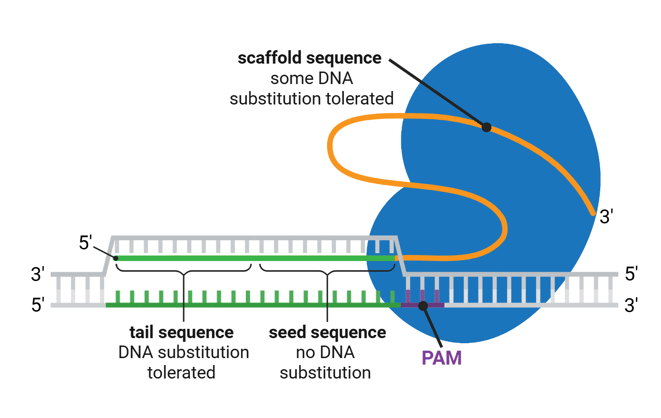 |
| Figure 1: The seed, tail, and scaffold sequences have different tolerances for substitution of DNA bases. Created with BioRender.com. |
What are the advantages?
- Reduced off-target activity. Introducing DNA bases into the tail sequence reduces the stability of the genome-bound complex. This decreases the Cas protein’s tolerance for mismatches, reducing potential off-target sites in the genome.
- Similar on-target efficacy. For perfect sequence matches, the complex is stable enough that the DNA substitution doesn’t disrupt it. Combined with the reduced off-target effects, this means the hybrid guides are more specific.
- Reduced bystander editing by adenine base editors (ABEs). In base editing, bystander edits are unintended changes to nearby bases that match the target base. It’s not yet clear why hybrid guides reduce bystander editing, and other kinds of base editors haven’t been tested yet.
- Cost. When synthesizing oligonucleotides, DNA bases are cheaper to include than RNA bases; using a hybrid oligo potentially halves the cost of a gRNA. This is especially relevant for high-throughput applications requiring many guide oligos, and it may allow more labs around the world to access these kinds of tools.
| Location of DNA substitution | Similar on-target efficacy | Reduced off-target activity | Reduced bystander editing | Lower cost |
| Seed sequence | Cas9: No activity Cas12: No activity |
N/A | N/A | N/A |
| Tail sequence | Cas9: Yes Cas12: Yes ABE: Yes |
Cas9: Yes Cas12: Yes ABE: Yes |
ABE: Yes | Yes |
| Scaffold sequence | Cas9: Yes Cas12: No |
Not tested | Not tested | Yes |
What are the caveats?
- It’s not universal. In one base editing test, some hybrid guides increased off-target editing instead of decreasing it (Whittaker et al., 2025). However, this result was unusual.
- Optimization is required for best results. Different targets benefit most from different DNA substitutions, although there are commonalities that may suggest good starting points.
- Hybrid guides only reduce certain undesired outcomes. Off-target editing of mismatched genomic sites and bystander editing are reduced, but hybrid guides are unlikely to impact other kinds of unintended edits, like guide-independent deamination by a base editor.
We at Addgene heard about RNA-DNA hybrid guides at the annual American Society of Human Genetics meeting. It’s great to hear about the creative new ways these tools are being developed and applied! As we like to say, sharing speeds science. Share how you’ve tried using hybrid guides in the comments below!
References and Resources
References
Kim, H., Lee, W., Oh, Y., Kang, S.-H., Hur, J. K., Lee, H., Song, W., Lim, K.-S., Park, Y.-H., Song, B.-S., Jin, Y. B., Jun, B.-H., Jung, C., Lee, D.-S., Kim, S.-U., & Lee, S. H. (2020). Enhancement of target specificity of CRISPR–Cas12a by using a chimeric DNA–RNA guide. Nucleic Acids Research, 48(15), 8601–8616. https://doi.org/10.1093/nar/gkaa605
Whittaker, M. N., Testa, L. C., Quigley, A., Brooks, D. L., Grandinette, S. A., Said, H., Dwivedi, G., Jindal, I., Volpp, D., Hacker, J. L., Qu, P., Wang, J. Z., Levine, M. A., Ahrens-Nicklas, R. C., Li, Q., Musunuru, K., Alameh, M.-G., Peranteau, W. H., & Wang, X. (2025). Improved specificity and efficiency of in vivo adenine base editing therapies with hybrid guide RNAs. Nature Biomedical Engineering, 1–13. https://doi.org/10.1038/s41551-025-01545-y
Yin, H., Song, C.-Q., Suresh, S., Kwan, S.-Y., Wu, Q., Walsh, S., Ding, J., Bogorad, R. L., Zhu, L. J., Wolfe, S. A., Koteliansky, V., Xue, W., Langer, R., & Anderson, D. G. (2018). Partial DNA-guided Cas9 enables genome editing with reduced off-target activity. Nature Chemical Biology, 14(3), 311–316. https://doi.org/10.1038/nchembio.2559
Additional resources on the Addgene blog
- Build Your CRISPR Vocabulary
- A Needle in a Base-Stack: Cas9 Structural Biology
- CRISPR 101: Cytosine and Adenine Base Editors
Additional resources on addgene.org
- Read the CRISPR guide
- Download the CRISPR 101 eBook
Topics: CRISPR, CRISPR gRNAs, CRISPR Protocols and Tips



Leave a Comment