


Throughout its 20-year history, Addgene’s mission has been to empower scientists to advance discoveries by reducing barriers, facilitating access to high-quality research materials, tools, and resources, while also fostering scientific collaboration. The first request through Addgene in 2004 allowed the transfer of a plasmid between two academic laboratories.
While Addgene is well known for facilitating research at nonprofit organizations, we have always sought to support scientists at all research institutions. In 2012, we shipped our first plasmid to an industry laboratory, and today we have almost ten thousand unique scientific tools available to industry scientists.
Because our collection of materials available to industry scientists has grown significantly over the past few years, we wanted to highlight a few of these exciting research tools. The materials available to industry cover many of the resources distributed by Addgene including plasmids, plasmid kits, pooled libraries, and antibodies. Our Distribution to Industry webpage is a great starting place to identify materials that may be useful to your research. But searching our website also allows for filtering for materials available to industry scientists by using “More Filters → Available to Industry.”
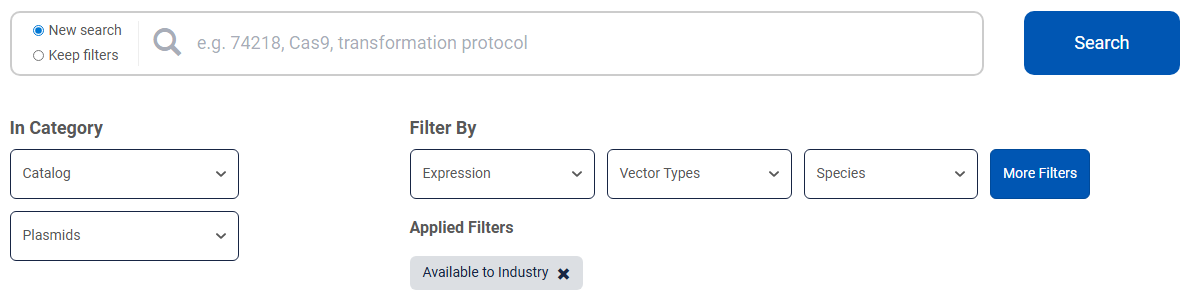 |
| Figure 1: Screenshot of Addgene's search functionality. |
Fluorescent proteins
One of the largest plasmid collections deposited with Addgene is the Michael Davidson Fluorescent Protein Collection. Approximately 1,800 of these plasmids are currently available to industry scientists. These include empty backbones such as mEGFP-N1 for expression in mammalian cells or mEGFP-pBAD for bacterial expression, as well as a number of fusions for cellular localization studies including mEmerald-Mito-7, mTagBFP2-Farnesyl-5, and EGFP-Tubulin-6.
CRISPR
OpenCRISPR-1, an AI-generated gene editor deposited by Profluent Bio, maintains Cas9 architecture, but is almost two hundred mutations away from any known Cas protein. This construct can be used with the AI generated synthetic guide RNA sequences found in OpenCRISPR-1 sgRNA-16nt stem and OpenCRISPR-1 sgRNA-12nt stem. In their manuscript, the research team validated editing efficiency and specificity in HEK293T cells.
Laboratory tools
Numerous plasmids for the production of laboratory enzymes have also been made available to researchers in industry. These include polymerases such as Taq (pOpen_taq), restriction enzymes including DpnI (pOpen-DpnIR) and EcoRI (pOpen-EcoRIR), and the reverse transcriptase MMLV RT (pET-19b_MMLV-RT). Many of these tools were made available as part of the FreeGenes Project Open Enzyme Collection, which includes DNA ligases, DNA and RNA polymerases, restriction endonucleases, and reverse transcriptases.
New England Biolabs has deposited plasmids for their SNAP- and CLIP-tag labeling system. These plasmids allow for a gene of interest to be cloned into the pSNAP-tag (m) Vector or pCLIP-tag (m) Vector to generate a tagged fusion protein. Fusion proteins can then be covalently labeled with a molecule such as biotin or a variety of fluorophores.
The Promega Plasmid Collection includes over 600 plasmids such as luciferase reporters for gene expression analysis and tools for tracking and detecting proteins fused to NanoLuc, HaloTag, SmBiT, and LgBiT. These plasmids are available to researchers as both purified plasmid DNA, for quick use in your experiments, as well as our traditional bacterial stab format.
Viral vector production
Plasmids for producing AAV vectors are also available to industry scientists. These include expression plasmids for the AAV2, AAV5, AAV6, and AAV11 Cap proteins. Additionally, transfer plasmids such as empty backbones, a FlpO expression construct, and calcium sensors are also available.
Affinity reagents
All of the antibodies distributed by Addgene are available for request by researchers in industry. These include antibodies targeting protein tags such as HA or His. The Neuroscience Antibody Collection includes over 150 antibodies for neuroscience applications, many of which were developed by the James Trimmer Laboratory. Through our partnership with the Institute for Protein Innovation, Addgene also distributes over 30 recombinant antibodies targeting glypicans and integrins.
The Stasevich Lab's Frankenbody plasmids (set 1 and set 2) allow researchers to visualize single molecules and nascent peptides in live cells. These scFv hybrids have specificity to epitope tags such as HA or FLAG and are fused with different fluorescent proteins. The collection includes plasmids for use in mammalian cells as well as those that can be used in bacterial cells for protein purification.
Conclusion
As Addgene’s collection of research tools available to industry researchers continues to expand, we encourage you to visit our Distribution to Industry webpage for the most up to date information. If you are a depositing lab or Technology Transfer Office interested in expanding the availability of your materials to industry scientists, please reach out to us at help@addgene.org and we’d be happy to help support you in this process.
Topics: Scientific Sharing



Leave a Comment