


Do you have a green thumb — or, perhaps, are you one of those people who kills every plant they touch? The whole trouble with houseplants is they can’t bark, meow, or cry when they need something. But what if we could equip plants with a way to warn us about concerning growing conditions?
That was the goal of Dmitri A. Nusinow’s team. In the plant biology world, many of scientists’ favorite model organisms belong to a group called dicots — think Arabidopsis thaliana. However, many of the world’s food crops, including rice, wheat, and corn, belong to the genetically distinct group of monocots… and many genetic tools developed in dicots are ineffective in monocots.
In their recent work, Dr. Dong-Yeon Lee in the Nusinow lab at the Donald Danforth Plant Science Center adapted a ligand-induced genetic circuit to monocots, making the plants into living biosensors that turn purple when they detect a specific molecule. By combining this approach with receptors for problematic ligands, crops could report the presence of chemical contaminants in their fields. The authors call these “sentinel plants.”
 |
|
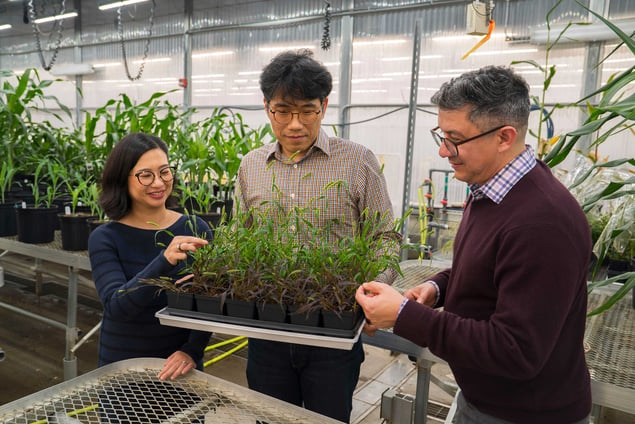
Figure 1: Dr. Malia Gehan, Dr. Dong-Yeon Lee, and Dr. Dmitri Nusinow observe sentinel plants growth with (purple) or without (green) ligands they are designed to detect. Photo courtesy of Kristina DeYong, Donald Danforth Plant Science Center. |
The plants’ purple comes from an anthocyanin, an endogenous pigment typically produced as part of a stress response. The team identified the genes required to activate the anthocyanin synthetic pathway and assembled them into a synthetic cassette induced by one of several ligands. Plants showed persistent coloration over a month after treatment.
Several different ligands could turn the plants purple, though poor uptake limited the response for some ligands. But Dr. Malia Gehan’s team also assessed hyperspectral imaging approaches for detecting plant pigmentation from an aerial perspective — what you’d see in a photo of a field of crops taken from above. A trained machine learning algorithm was able to detect anthocyanin even when it was not obvious to the naked eye. Still, this system would be best suited for detection of chemicals that readily diffuse through plant tissue. Those might be the most important to know about, anyway!
Interested in developing these sentinel plants further? The plasmids are at Addgene! In addition, the authors’ data processing is available via github, and Dr. Gehan recommends a tutorial on hyperspectral imaging.
Step aside, green thumbs. Perhaps in the future we’ll be discussing who has a purple thumb!
References and Resources
References
Lee, D.-Y., Acosta-Gamboa, L., Saleh, L., Pathak, S., Swyers, N., Morgan, A., Meerdink, S., Kuzio, C., Calderon, S., Sheng, H., Kenney, S., Zare, A., Gehan, M., & Nusinow, D. A. (2025). Remote Sensing of Endogenous Pigmentation by Inducible Synthetic Circuits in Grasses. Plant Biotechnology Journal. https://doi.org/10.1111/pbi.70480
Additional Resources
- Browse our collection of plant plasmids
- Check out the Plant Biology tag on our blog
Topics: Plant Biology



Leave a Comment