


Every few months we highlight some of the new plasmids, antibodies, viral preps, and more in the repository through our Hot Plasmids articles. This month, check out hot new AAV packaging plasmids, CRISPR libraries, and more!
Read on to learn more about:
- Addgene's own AAV2 and AAV5 packaging plasmids
- TimeVault system for preserving transcriptomic state
- An engineered bacterial strain with a single stop codon
- Improved mouse and human CRISPR knockout libraries
- Neurexin and Neuroligin antibodies from IPI
Exceptionally stable variants of red fluorescent protein mScarlet3
By Mike Lacy
One of our most popular red fluorescent proteins just got a longevity boost! mScarlet3 is the brightest red fluorescent protein, but its modest photostability limits applications like long-term imaging or super-resolution techniques. The labs of Pingyong Xu and Zhifei Fu separately developed two highly stable variants to overcome this barrier. The Fu Lab designed mScarlet3-H (also known as mScarlet3-M163H), inspired by crystal structures and by the performance of an earlier variant mScarlet-H (Xiong et al., 2025). Meanwhile, the Xu Lab devised a mutagenesis and screening strategy to select photostable variants, resulting in mScarlet3-S2 (M163H/M66Q; the "S" is for "stable") (Ding et al., 2026).
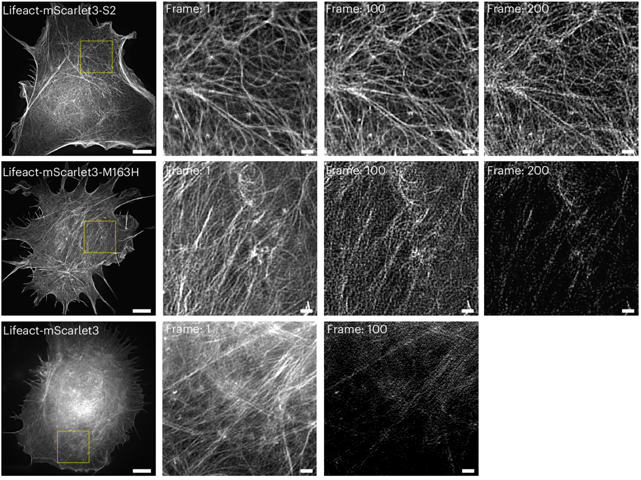
mScarlet3-S2 and mScarlet3-H showed up to 29- and 15-fold higher photostability than mScarlet3, respectively. Although they sacrifice some brightness (~20–30% as bright as mScarlet3, comparable or a bit better than mCherry), their photostability means they more than make up for it over the long term (Figure 1). mScarlet3-H was also stable under extreme conditions like heat and oxidation or protocols for tissue clearing and correlative light and EM imaging.
 |
|
Figure 1: SIM images of live COS-7 cells expressing Lifeact fused to mScarlet3-S2, mScarlet3-M163H (mScarlet3-H), or mScarlet3. Reproduced from Ding et al. (2026) under CC BY-NC-ND license. |
Both labs deposited several constructs fused with popular subcellular markers like Lifeact, Sec61β, H2B, and more. Plus, the Xu Lab included the M163H variant in their screening, so read Ding et al. (2026) for head-to-head comparisons of these proteins in identical conditions.
Find mScarlet3-S2 and mScarlet3-H plasmids here!
Ding, Y., He, W., Wang, K., Xue, F., … Xu, P. (2026). A highly photostable monomeric red fluorescent protein for dual-color 3D STED and time-lapse 3D SIM imaging. Nature Methods, 23(1), 143–152. https://doi.org/10.1038/s41592-025-02962-2
Xiong, H., Chang, Q., Ding, J., Wang, S., Zhang, W., Li, Y., Wu, Y., … Fu, Z. (2025). A highly stable monomeric red fluorescent protein for advanced microscopy. Nature Methods, 22(6), 1288–1298. https://doi.org/10.1038/s41592-025-02676-5
Updated AAV2 and AAV5 packaging plasmids at Addgene
By Meghan Rego
Reliably achieving high yields for your viral vector preps can be a challenge. You probably know yield is influenced by many variables such as cell health, DNA quality, transgene size and sequence, reagents, and other conditions. Less appreciated, but also important, is the design of the packaging and helper plasmids themselves, including how the viral genes are arranged and regulated within the plasmid backbone.
Addgene designed and tested different configurations for AAV2 and AAV5 packaging plasmids and found two (pAAV2/2 and pAAV2/5) that consistently produced higher yields than previous versions — typically double or triple (Figure 2). Based on these results, early last year our lab switched to using these higher-yielding plasmids for our AAV Viral Vector Service, and you can use them in your lab too! To date, we've produced dozens of AAV preps using these new backbones and consistently observe high yields across a wide range of transfer plasmids.
 |
|
Figure 2: New packaging plasmid increases AAV yield. Plasmids pAAV-hSyn-DIO-hM3D(Gq)-mCherry (Addgene #44361) and pAAV-hSyn-DIO-mCherry (Addgene #50459) were packaged into AAV using Old (Addgene #104964) or New (Addgene #232922) pAAV2/5. Average + standard deviation from n = 2 (pAAV-hSyn-DIO- hM3D(Gq)-mCherry) or 3 (pAAV-hSyn-DIO-mCherry) replicates. |
Over 60 labs have already ordered these new plasmids! Ready to try them out yourself? These new AAV plasmids are available to all academic and industry customers. Check out our AAV production protocol or let Addgene make the AAV for you: browse our in-stock AAV or try our Packaged on Request service so you can spend less time producing virus and more time doing science.
Find Addgene's new AAV packaging plasmids here!
Secure self-storage in the vault
By Emily P. Bentley
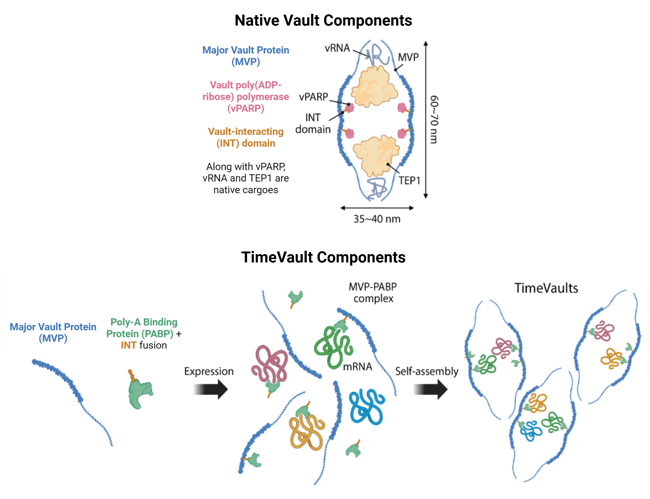
Like a time capsule you bury in your yard, TimeVault preserves the present for study in the future. Specifically, the present transcriptome. The system, developed in the Fei Chen Lab, relies on the vault ribonucleoprotein complex: a large, barrel-shaped structure of unknown function that is nevertheless conserved across mammals. TimeVault works through a fusion of an endogenous vault-interacting (INT) domain and Poly-A binding protein, allowing mRNA transcripts to be encapsulated (Figure 3). In this way, TimeVault samples the cytosolic transcriptome and preserves it for later retrieval (Chao et al., 2026).
 |
|
Figure 3: Schematic of native vault (top) and TimeVault (bottom) components. Adapted from Chao et al., 2026. Created with BioRender.com. |
TimeVault is non-destructive, and vaults are inherited by daughter cells. Cargo transcripts are resistant to RNase degradation for days in both lysate and living cells, so transcriptome states can be recorded with cell identity preserved. The team used TimeVault to show that a subpopulation of PC9 lung cancer cells had a distinct transcriptome that was associated with future resistance to drug treatment, even though key features had partially disappeared from that population after treatment.
TimeVault can be delivered as a single construct or stably transfected, comes in either a Tet-On or Tet-Off format, and did not alter cell viability or global gene expression in tests. It's about Time we had a tool like this!
Chao, Y.-K., Wu, M., Gong, Q., & Chen, F. (2026). A genetically encoded device for transcriptome storage in mammalian cells. Science, eadz9353. https://doi.org/10.1126/science.adz9353
An engineered bacterial strain with a single stop codon
By Emily P. Bentley
That's right: just one! Simple enough to summarize, but far from simple to create.
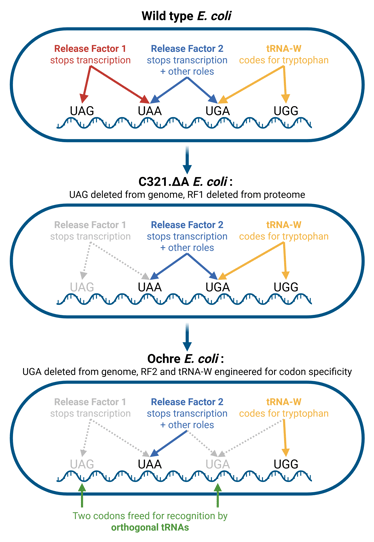
Most organisms have three stop codons: UAG ("amber"), UAA ("ochre"), and UGA ("opal"). Previous work by the Jesse Rinehart, George Church, and Farren Isaacs labs engineered an E. coli strain to use only two, by deleting the machinery that recognizes UAG and deleting all instances from the genome (Lajoie et al., 2013). But the remaining termination machinery has multiple functions, and furthermore, UGA is sometimes recognized as a tryptophan codon (usually coded by UGG) through wobble pairing (Figure 4). Now, through a massive effort of protein and genome engineering, the Rinehart and Isaacs labs were able to isolate each of these functions to a single codon (Grome et al., 2025).
 |
|
Figure 4: Summary of the changes from wild type E. coli to the new Ochre strain. Adapted from Grome et al., 2025. Created with BioRender.com. |
Because both stop codons were "freed" of their evolved purpose, they became available for new applications: incorporating artificial amino acids into proteins. The team demonstrated 99% on-target incorporation of non-standard amino acids into reporter proteins. This feat of bioengineering could allow fast and cheap production of synthetic proteins, enable genetic isolation of modified organisms, and set the stage for future recoding efforts.
Find the Ochre bacterial strain here!
Grome, M. W., et al. (2025). Engineering a genomically recoded organism with one stop codon. Nature, 639(8054), 512–521. https://doi.org/10.1038/s41586-024-08501-x
Lajoie, M. J., et al. (2013). Genomically recoded organisms expand biological functions. Science, 342(6156), 357–360. https://doi.org/10.1126/science.1241459
Wine and dine using CRISPR knockout libraries
By Alyssa Shepard
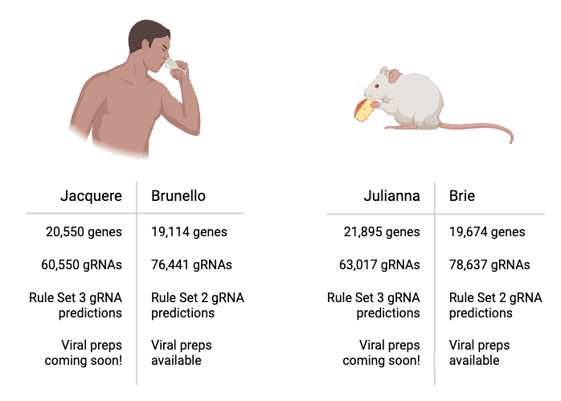
Connoisseurs of CRISPR knockout screens are always hungry for the best, most efficient set of guide RNAs. To cater to these tastes, the labs of John Doench and David Root have created the next expert pairing of Jacquere and Julianna, lentiviral CRISPR knockout libraries for genome-wide screens in humans and mice, respectively. The new libraries are updated versions of Brunello and Brie, popular pooled libraries that Addgene has distributed to hundreds of labs around the world.
Optimizations in the Jacquere and Julianna libraries aim to increase the quality of data you can get from your CRISPR screen (Figure 5). First, the gRNAs for the Jacquere and Julianna libraries are designed against the latest assemblies of the human and mouse genomes and feature additional gene targets for each species. Second, they use updated gRNA design models, to balance on-target activity with off-target effects to select only the most efficient and specific guides. Specifically, the design process utilizes Rule Set 3, a prediction model developed by the Doench lab that includes more training data and also takes into account variations in the tracrRNA, the structural sequence of a gRNA.
The Jacquere library was tested in two human cell lines, and was found to be especially useful in minimizing false positives in screening data. Increasing the quality of data coming from the genome-wide screens will likewise increase the quality and accuracy of downstream applications.
 |
|
Figure 5: Brief comparison of the Jacquere/Brunello and Julianna/Brie CRISPR libraries. Created with BioRender.com. |
Dig into the Julianna and Jacquere libraries, and stay tuned for their viral preps coming soon!
DeWeirdt, P. C., et al. (2022). Accounting for small variations in the tracrRNA sequence improves sgRNA activity predictions for CRISPR screening. Nature Communications, 13(1), 5255. https://doi.org/10.1038/s41467-022-33024-2
Drepanos, L. M., et al. (2025). Balancing off-target and on-target considerations for optimized Cas9 CRISPR knockout library design. bioRxiv. https://doi.org/10.1101/2025.08.26.672375
Neurexin and Neuroligin antibodies from IPI
By Ashley Waldron
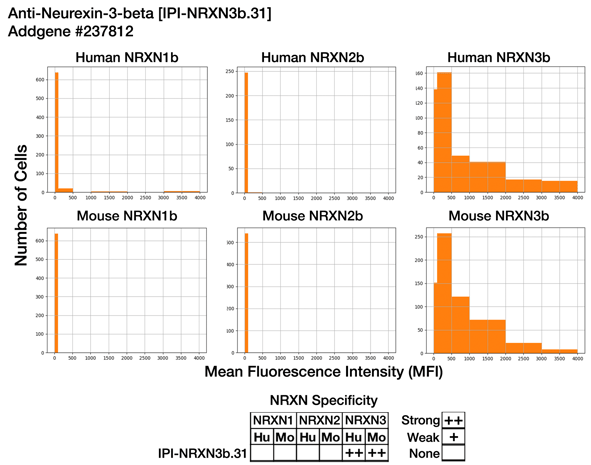
Neurexins and neuroligins play critical roles in synaptic formation and function, yet the regulation and interactions of the many different family members have been difficult to unravel due to a lack of suitable tools. To address this challenge, the Institute for Protein Innovation (IPI) is developing highly selective recombinant antibodies targeting neurexins and neuroligins. The first set, targeting human Neurexin1, 2, and 3, and Neuroligin3, is now available through Addgene! All four have been tested in IPI's immunofluorescence-based specificity assay, which tests the antibody's ability to recognize their target and not closely related proteins in cells (Figure 6).
 |
|
Figure 6: To test family-wide cross reactivity, ExpiCHO cells were transfected with human and mouse variants of each NRXNb family member and labeled with Anti-Neurexin-3-beta [IPI-NRXN3b.31] (Addgene #237812). Each graph depicts the mean fluorescence intensity of Anti-Neurexin-3-beta labeling for imaged cells. Image from Morano A, Riedel T, Moshinsky D, 2025. Addgene Report, https://doi.org/10.57733/addgene.3waajp. |
These tools will enable researchers to interrogate the distinct roles of neurexin and neuroligin family members in synapse formation and neurological disease. And they're just the first from IPI's Synaptic Cleft Antibody Collection! Keep an eye out for new antibodies targeting other synaptic proteins coming soon.
Find IPI's Neurexin and Neuroligin antibodies here!
That's all for now! If you've tried these tools in your lab, let us know how it went in the comments.
Topics: Hot Plasmids



Leave a Comment