


In July, Addgene hosted a webinar titled “CRISPR Pooled Libraries: Optimizing Knockout Library Design.” If you missed it, don’t worry! Not only is it still available to watch, but this post covers the same material. The webinar featured:
- Andrew Hempstead, PhD: Addgene’s Associate Director of Scientific Engagement and Success, who offered guidance on choosing, ordering, and using a CRISPR pooled library, and
- Laura Drepanos: a Computational Associate in the Genetic Perturbation Platform (GPP) at the Broad Institute, who provided an insider account of how CRISPR knockout libraries are designed and refined.
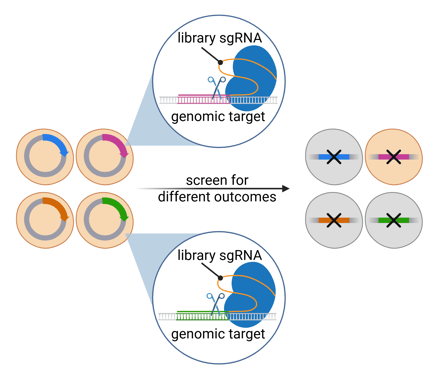
Say we wanted to know what gene(s) cause a particular phenotype. To be thorough, we could disrupt each gene in the genome, one at a time, to see how the loss of that gene affects the outcome. How? It starts with a pooled library: a collection of plasmids that share the same backbone, differing only in a small region. Our experiment could use a CRISPR knockout pooled library, in which each plasmid expresses a gRNA to point Cas9 toward a target gene.
 |
|
Figure 1: CRISPR knockout screening with a pooled library. Created with BioRender.com. |
CRISPR pooled libraries come in several variations:
- One-vector versus two-vector systems: In one-vector systems, the pooled plasmids also include the Cas protein machinery, providing convenient all-in-one delivery. In two-vector systems, the pooled library only delivers the gRNA, allowing more flexibility in Cas protein selection and delivery method.
- Target genes: A pooled library might target a specific subset of genes — like metabolic genes, membrane proteins, or RNA-binding proteins — or every gene in the genome, as in our example.
- Impact: Once Cas9 reaches its target, the complex may upregulate, downregulate, edit, or completely disrupt the target gene. Our webinar focused on knockout libraries — the most popular type, which Andrew called “the workhorse in the field.”
| Library type | Components | Impact on target genes |
| Knockout | Wildtype (WT) Cas protein | Create insertions or deletions, rendering them nonfunctional |
| Activation | dCas9 + transcriptional activator | Activate transcriptional expression |
| Interference | dCas9 + transcriptional repressor | Inhibit transcriptional expression |
| Base Edit | Cas9n + deaminase | Convert one base to another |
| Prime Edit | Cas9n + reverse transcriptase | Create insertions, deletions, and base edits |
Improving genome-wide CRISPR knockout libraries
Some of the most popular libraries at Addgene are called Brie and Brunello, deposited by the GPP, which is led by David Root and John Doench. Both libraries enable genome-wide CRISPR knockout screens, and they’re named for a delicious pair: a cheese, Brie, for the mouse library, and a wine, Brunello, for the human library (Doench et al., 2016).
But Brie and Brunello were designed in 2016, and Laura and the team at the Broad Institute have been working to improve them in the decade since. Enter a new tasty pair: Julianna (a mouse library, and a cheese) and Jacquere (a human library, and a wine) (Drepanos et al., 2026).
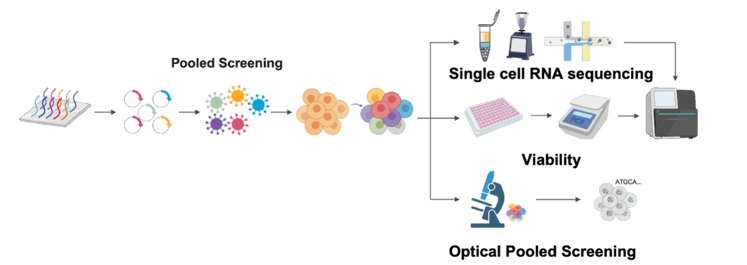
One of the key goals for these new libraries was to make them smaller. To ensure every gene is successfully knocked out, Brie and Brunello contain four different gRNAs per gene, for over 75,000 total gRNAs each. But the cost of most experiments scales with the size of the library, and newer screening technologies only compound that cost. Although optical pooled screening and single-cell RNA sequencing produce richer data than simple “did it live or die” viability screening, Laura estimated they also cost 10 to 25 times more per gRNA.
 |
|
Figure 2: Schematic of pooled screening approaches. Image provided by Laura Drepanos. |
So how to use fewer gRNAs without compromising genome-wide targeting? The team used four tricks.
Improved modeling of gRNA activity
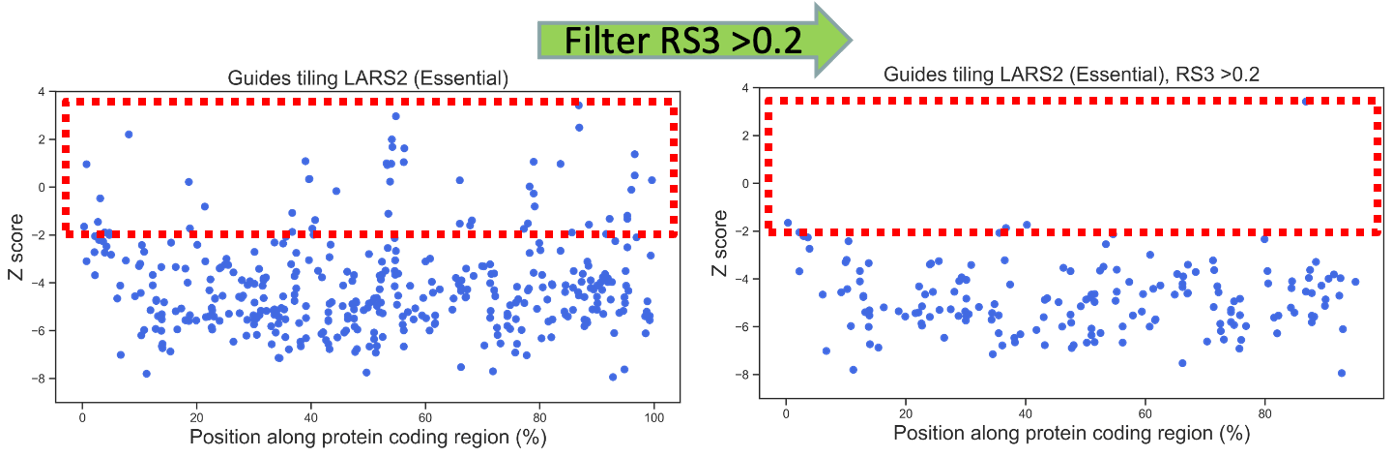
To assemble such a large library, Laura’s team relies on computer models that predict whether a particular gRNA will successfully direct Cas9 to disrupt the target gene. Julianna and Jacquere are based on a new model, Rule Set 3, which was trained on the largest CRISPR dataset so far (DeWeirdt et al., 2022). More confidence per gRNA means fewer gRNAs are needed to cover the full genome.
 |
|
Figure 3: A tiling screen of LARS2, an essential gene, with and without Rule Set 3 (RS3) filtering. gRNAs target the entire protein coding region (x axis) and cell viability is assessed (y axis). Successful disruption of LARS2 kills cells. Before RS3 (left), some gRNAs fail to effectively kill cells (red box), but when RS3 is used, all selected guides effectively kill cells. Image provided by Laura Drepanos. |
Strategic treatment of off-target risks
No matter how effectively a gRNA disrupts its target, it can’t be included in the library if it also causes significant off-target damage. Laura explained, “We trained a model that predicts exactly at what point a guide [RNA] has enough off-target sites to reduce viability due to a high number of double-stranded breaks.” This way, they can exclude truly problematic gRNAs but keep effective gRNAs that only pose low risks.
Accounting for individual variation
Humans — obviously — do not all share the same genome. When selecting gRNAs for Jacquere, the team avoided sites of frequent genetic mutation, so that individual variation is less likely to disrupt targeting.
This population-level variation data was only available for humans. As a result, this benefit applies only to Jacquere, not to the mouse library Julianna.
Combining multiple gene catalogs
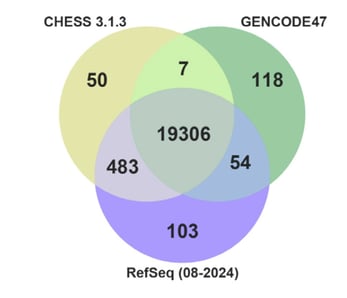
It’s harder to achieve “every gene in the genome” when you realize not all sources agree on the number of genes! The GPP compiled several different lists: in addition to commonly used catalogs RefSeq and GENCODE, they also used CHESS, which identifies genes from expression data. “Historically, this resource [CHESS] has predicted genes that are later recognized by the other catalogs,” Laura told us. “This is a way of almost future-proofing the library, such that if new genes are discovered in the future, there's a slight chance that they are actually already included in Jacquere.”
 |
|
Figure 4: The number of genes in each catalog and their overlap. Reproduced from Drepanos et al., 2026 under a CC BY-NC-ND license. |
Using these resources and updated gene annotations, the proportion of genes missing from the library improved from 2.2% in Brunello to only 0.6% in Jacquere.
Assessing the updated libraries
With these improvements, the Julianna and Jacquere libraries are able to use only three gRNAs per target gene (instead of four like their predecessors) and still have improved performance.
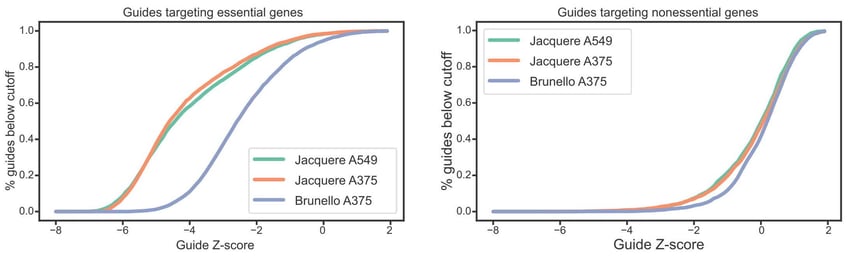
Figure 5 shows guide depletion following screening with either the Jacquere or Brunello pooled libraries. On the left, essential genes are being targeted, so guide depletion demonstrates effective targeting: a significantly higher fraction of Jacquere guides are depleted, relative to the Brunello guides. On the right, non-essential genes are being targeted, so guide depletion reflects off-target toxicity. While Jacquere shows slightly increased off-target toxicity compared to Brunello, Laura described the outcome as a “minimal compromise” for a library that is 20% smaller.
 |
|
Figure 5: Stratified analysis of false positive rates and false negative rates in screening data of the Jacquere and Brunello libraries in A549 and A375 cell lines. Guide Z scores are calculated relative to the mean and standard deviation of intergenic control guides, and the plots demonstrate the percentage of guides targeting essential (left) or nonessential (right) genes that deplete at the Z score cutoff, as indicated on the x axis. Reproduced from Drepanos et al., 2026 under a CC BY-NC-ND license. |
Using Julianna and Jacquere
Both Julianna and Jacquere are available from Addgene in a two-vector system, meaning the libraries do not express Cas9. The GPP recommends this plasmid expressing Cas9, though the researcher is free to choose another. In addition, Jacquere is also available in a convenient one-vector system.
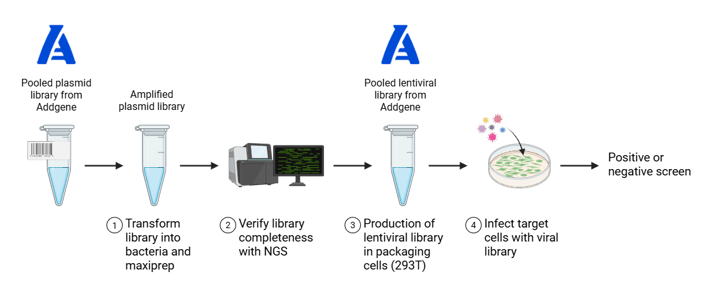
Lentiviral delivery is recommended for both Julianna and Jacquere. Researchers can choose to receive the pooled library as a plasmid library and produce lentivirus in their own labs, or to receive it as a lentiviral prep. For all lentiviral preps, Addgene’s quality control team verifies library completeness with next-generation sequencing, determines the titer, and (for the one-vector system) confirms the presence of Cas9 through sequence analysis.
 |
|
Figure 6: Steps to use a pooled library for lentiviral screening. Created with BioRender.com. |
On both pooled library pages, you’ll find a Resource Information section that includes protocols for library amplification and sequencing and a link to the GPP’s data analysis script.
Still have more questions? We’ll include the transcript from our live Q & A session below. You can always reach out to us at help@addgene.org to speak with a member of our Scientific Applications Team, who can assist with finding and using any of the pooled libraries distributed by Addgene.
Watch our full webinar here:
You can also check out our previous webinar CRISPR 101: Getting Started with CRISPR on our YouTube channel.

Q & A
How do I decide between a knockout activation or interference library for my question?
Andrew: That's a great question and definitely something to think about before embarking on your experiments. So a CRISPR knockout screen is great for identifying strong hits, and this is due to that loss of gene function that we spoke about. But there can be some limitations due to this. For example, if you're studying an essential gene, a CRISPRi [CRISPR interference] screen might instead be a good option where you can titrate down the expression of that gene rather than completely eliminate it.
Alternatively, if you're studying a set of genes that aren't highly expressed, CRISPRa might be a good approach, where you can increase the expression and then look at different phenotypes that way.
For any new experiments that you're taking on though, we have some great resources available on our website, so we'd recommend starting there. But if you do have any questions or want to chat through your approach, feel free to give us a call or send us an e-mail and we can help with that.
Is there a CRISPRa or CRISPRi version of these libraries planned?
Laura: Different design considerations go into designing these modalities because, by nature, they are slightly distinct. But, a recently updated CRISPRi approach, which has some similar considerations to the Jacquere library, we released in a preprint earlier this year and that's under review for a journal. That library is out. It's called Katsano.
So that's for CRISPRi, and we're currently in the works of developing a CRISPRa library, but that should be available soon.
With the Julianna pooled library, are these guides available to be used with various scaffolds? For example, does the library require Chen tracrRNA or can other scaffolds be used?
Laura: These libraries are designed to be agnostic to the context. You may have noticed that the Julianna library is designed and optimized for the Chen tracrRNA. Basically, what that means is that when we are selecting guides to target each gene, we're looking at those that are most predicted to be active, given that the tracrRNA employed is the Chen tracrRNA.
However, that's not the only consideration that goes into mind when selecting guides. So whereas the guides are optimized for the Chen tracrRNA… They still have high Rule Set 3 scores, meaning that they still have a good chance of being active.
It's still suitable for other scaffolds, it's just probably best with the Chen.
Do you have any MLV [murine leukemia virus]-based variations of Julianna (not lenti) for better infection of mouse T cells?
Andrew: Unfortunately at this time, it's only available as a lentiviral preparation. It's possible in the future that the GPP [the Genetic Perturbation Platform at the Broad Institute] or another lab might create an MLV version and that could, in the future, be distributed through Addgene.
What analysis tools do you recommend for hit calling after sequencing?
Laura: In the publication that Andrew mentioned is linked with the Addgene page for Jacquere, we discuss different approaches, survey them, and weigh the pros and cons of using one versus the other.
But I would say, to put it succinctly, what matters is that you're using an approach that isn't allowing a single individual guide to determine what the effect of a certain gene is. Because no matter how carefully the library is designed, it's always possible that a single guide may be ineffective for whatever reason in that particular context, or might have an off-target effect that wasn't predicted a priori.
So just whatever approach you're doing, make sure that it's not one individual guide that determines the effect of perturbing that gene.
Is the aggregate CFD [Cutting Frequency Determination] approach [to predict off-target risks of gRNAs] validated experimentally or is it purely computational?
Laura: We trained and optimized the aggregate CFD approach on a tiling screen in a single cell line, but we validated it on DepMap data which is across over 1,000 cell lines… [which] vary widely in their sensitivity to double-stranded breaks. And so by validating on this large data set across many different cell lines, we found that the performance of aggregate CFD was consistent. So it really should be able to be relevant and effective for a cell line experiment.
Obviously, we don't really have data on its performance in vivo, but at least for a broad range of cell lines.
Thanks to Labroots for hosting the webinar, and to Andrew and Laura for their presentations!
Andrew Hempstead is the Associate Director of Scientific Engagement and Success at Addgene where he oversees Scientific Applications, Customer Success, and Contracts Management. Throughout his time at Addgene, he has collaborated with researchers to make their tools accessible to the greater scientific community. Prior to joining Addgene, Andrew received a PhD in Molecular Microbiology and worked with the Department of Public Health to track infectious disease outbreaks.
Laura Drepanos is a Computational Associate on the Genetic Perturbation Platform R&D team led by John Doench at the Broad Institute of MIT and Harvard. Laura has been on the team for three years and has been involved in experimental design and analysis in efforts to optimize functional genomics technologies. She will begin a Computational Biology and Bioinformatics Ph.D. program at Duke University in September 2026.

References and Resources
References
DeWeirdt, P. C., McGee, A. V., Zheng, F., Nwolah, I., Hegde, M., & Doench, J. G. (2022). Accounting for small variations in the tracrRNA sequence improves sgRNA activity predictions for CRISPR screening. Nature Communications, 13(1), 5255. https://doi.org/10.1038/s41467-022-33024-2
Doench, J. G., Fusi, N., Sullender, M., Hegde, M., Vaimberg, E. W., Donovan, K. F., Smith, I., Tothova, Z., Wilen, C., Orchard, R., Virgin, H. W., Listgarten, J., & Root, D. E. (2016). Optimized sgRNA design to maximize activity and minimize off-target effects of CRISPR-Cas9. Nature Biotechnology, 34(2), 184–191. https://doi.org/10.1038/nbt.3437
Drepanos, L. M., Srikanth, S., Kaplan, E. G., Shah, S. T., Velasco, B. E., Merzouk, S., & Doench, J. G. (2026). Balancing off-target and on-target considerations for optimized CRISPR-Cas9 knockout library design. Cell Genomics, 6(5), 101190. https://doi.org/10.1016/j.xgen.2026.101190
Additional resources on the Addgene blog
- Viral Vectors 101: Preparing Pooled Libraries
- Pooled Library Amplifications
- A Tour of Addgene’s Most Popular Pooled Libraries
Resources on Addgene.org
Topics: CRISPR, CRISPR Pooled Libraries



Leave a Comment