This article was originally published on the Society for Laboratory Automation and Screening (SLAS) Electronic Laboratory Neighborhood. Work/life balance. Is it truly possible to bring all aspects of our lives under control? Balance is a myth and should not even be the real ...
This is the fifth and final post in the Addgene Blog Mentoring for Scientists Series. The entire series and additional resources can be downloaded in E-Book format at the end of this post. If you have been following the posts in this Mentoring for Scientists series, you have: ...
This is the fourth post in the Addgene Blog Mentoring for Scientists Series. I have been thinking a lot about Mentoring for over 10 years. Many successful scientists describe having a “posse” of mentors as one key to their success. But how do you find these elusive teachers, ...
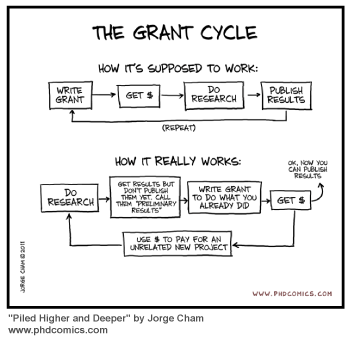
Research at universities typically requires funding from a variety of government and academic institutions. New graduate students may assume that their advisor alone applies for these competitive grant applications; however, in some cases, your advisor may choose to allot some ...
“Learning is not attained by chance, it must be sought for with ardor and attended to with diligence.” - Abigail Adams, 1780 There are potential mentors all around you. This third article in the Addgene Blog Mentoring series will cover 2 of the 7 mentoring questions I set out to ...
Which graduate student hasn’t been asked the question: “Academia or industry?” Once academia was the clear answer with a well-defined path to professorship. But recently a downward trend in funding and space in academic research labs has more students looking for other options. ...
A scientist-in-training will spend 10 or more years with a small number of formal advisors learning how to be a scientist. It is shocking how little pre-work most PhD students and postdocs do to ensure the advisors they choose will be ones that help them succeed after the ...
Welcome to 2014! Get excited, it’s a new year. A time for resolutions: to wake up and get to the lab earlier, to read that stack of papers on your desk, and to tackle some new experiments before the next R01 is due. But what about organizing yourself and your lab? Organizing ...