


If you came to Addgene looking for a plasmid sequence and ran into a login request instead, we understand why that’s frustrating. You knew exactly what you needed, and now there’s one more step between you and the information you’re looking for. We didn’t add this step to slow you down. We added it to protect the valuable resource we have built together.
 |
|
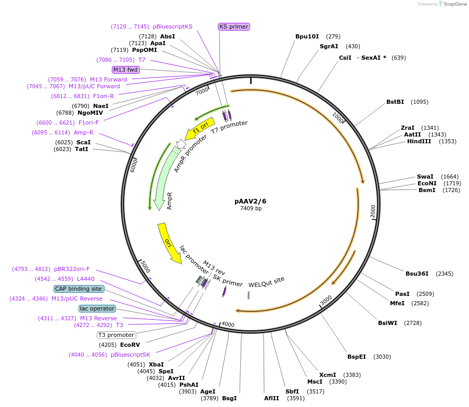
Figure 1: Plasmid map of pAAV2/6 (Addgene #240485), an AAV packaging plasmid expressing AAV2 Rep and AAV6 capsid proteins. |
How the world handles data has changed
For most of Addgene’s history, anyone could download any plasmid sequence on our site with no login or barrier. That’s been true since 2004, because Addgene exists to get scientific materials and information into researchers’ hands with as few obstacles as possible.
That simplicity made sense in a different era, but the way sequence data is accessed and used has changed dramatically in recent years. Today, automated tools can request sequence data in bulk, without a specific scientist, lab, or project attached to each request. Managing bot traffic costs us significant time and money to handle. More concerning, it means we lose track of whether the data we’re sharing is actually reaching the people it was meant for.
What you’re actually getting when you download a sequence from us
A sequence from Addgene isn’t just a file that a depositor submitted. Every one of the 170,000+ plasmids in our collection gets independently sequenced, curated, and analyzed by our team before it ever reaches you — and if something doesn’t match what’s expected, we investigate and resolve it, whether that means updating the sequence, confirming the discrepancy doesn’t affect function, or sourcing a new sample. So when you download a sequence from us, you’re not getting a raw submission; you’re getting a verified record you can build on with confidence.
Honoring the intent behind shared materials and data
When someone deposits a plasmid with us, they’re handing over something they may have spent years developing, expecting it to reach the colleagues who can put it to use or build on it to create the next tool. When we store and distribute that material, we have a responsibility to respect the creator while making sure what they shared actually gets used as intended.
A free account gives us a simple way to do that. It’s an added layer of accountability, enough to make it harder for bots to harvest everything and a lot easier to know a real person is on the other end.
That simple login step protects your work, and it lets the wider community keep sharing freely, with more visibility into who’s accessing it and why. It also protects Addgene. We’re a nonprofit, and every dollar we spend responding to and preventing misuse is a dollar we’re not spending on our mission. If we can’t take care of what people share with us, we can’t keep doing this work.
Open science and responsible stewardship aren’t at odds
Addgene champions open science, and we don’t see a conflict between that and asking users to log in to access sequence data. Openness survives because people can count on it. Scientists share freely because they believe their work will be used responsibly. Once that confidence goes away, people stop sharing, and everyone loses access, not just the handful of people misusing it. Taking care on our end is what keeps the door open for everyone else.
Creating an account is free, fast, and open to researchers worldwide
None of this is meant to be a hurdle, so we’ve kept it as light as possible. Creating an Addgene account is free, only takes a moment and an email address, and is open to researchers worldwide, whether or not you’re requesting materials.
Once you’re in, you’ll have access to sequence data, and you can request access to the Developers Portal if you’re interested in bulk access. The data remains openly shared with the research community, exactly as intended.
Our mission hasn’t changed
This wasn’t a decision we made lightly, and we’ll keep looking for ways to make access easier without putting the community at risk. Our mission is still connecting researchers with the high-quality materials and information they need, as openly as possible. Thank you for being part of a community that makes open science worth protecting.
Still have questions? Our Help Center article explains the login requirement, links you to account creation, and walks through getting to sequence data once you’re signed in.
-Addgene
References & Resources
References
Hinchliffe, L. J. (2025, June 23). Are AI bots knocking digital collections offline? An interview with Michael Weinberg. The Scholarly Kitchen. https://scholarlykitchen.sspnet.org/2025/06/23/are-ai-bots-knocking-digital-collections-offline/
Kwon, D. (2025). Web-scraping AI bots cause disruption for scientific databases and journals. Nature, 642(8067), 281–282. https://doi.org/10.1038/d41586-025-01661-4
Mueller, B., Danis, C., & Lavagetto, G. (2025, April 1). How crawlers impact the operations of the Wikimedia projects. Diff. https://diff.wikimedia.org/2025/04/01/how-crawlers-impact-the-operations-of-the-wikimedia-projects/
Weinberg, M. (2025). Are AI bots knocking cultural heritage offline? GLAM-E Lab. https://www.glamelab.org/products/are-ai-bots-knocking-cultural-heritage-offline/
Topics: Addgene News



Leave a Comment